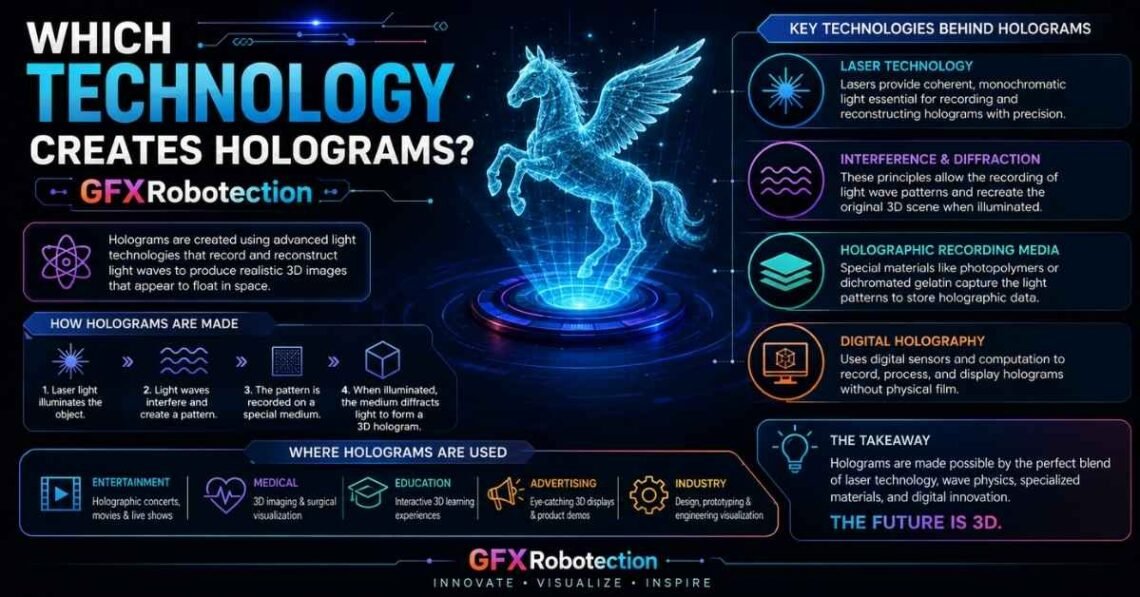
Imagine seeing a three-dimensional image floating in midair without needing special glasses. That futuristic experience is possible thanks to holographic technology. Which technology creates holograms GFXRobotection? The simple answer is that holograms are primarily created using laser-based holography, digital holography, and advanced light projection technologies that record and reconstruct light waves to produce realistic 3D images.
These technologies continue to evolve, making holograms more practical for healthcare, education, entertainment, security, and business.
In this guide, you’ll learn how holograms work, the technologies behind them, their real-world applications, and why holography is becoming one of the most exciting innovations in modern technology.
What Does Which Technology Creates Holograms GFXRobotection Mean?
The phrase which technology creates holograms GFXRobotection refers to understanding the technologies that generate holographic images while also emphasizing digital innovation, visual technology, and secure technological advancements.
Unlike ordinary photographs, holograms capture both the intensity and direction of light, allowing viewers to see objects from multiple angles as if they were physically present.
Modern holograms rely on several technologies working together, including:
- Laser holography
- Digital holography
- Optical imaging
- Light interference
- Wavefront reconstruction
- Spatial light modulators (SLMs)
- Computer-generated holography (CGH)
What Is Holography?
Holography is a technique that records light waves reflected from an object and recreates them to produce a realistic three-dimensional image.
Unlike traditional photography, which captures only light intensity, holography records both:
- Light intensity
- Light phase information
This additional data creates the illusion of depth and realistic perspective.
Which Technology Creates Holograms?
Several advanced technologies make holograms possible. Each serves a unique purpose depending on the application.
Laser Holography
Laser holography remains the most widely used technology for producing true holograms.
It works by splitting a laser beam into two parts:
- The reference beam
- The object beam
When these beams meet, they create an interference pattern that stores detailed information about the object. When illuminated correctly, the recorded pattern reconstructs the original three-dimensional image.
Digital Holography
Digital holography replaces traditional photographic plates with digital image sensors.
Advantages include:
- Faster image processing
- Higher accuracy
- Easy computer editing
- Real-time visualization
- Scientific measurements
Researchers commonly use digital holography in laboratories and medical imaging.
Computer-Generated Holography (CGH)
Computer-generated holography creates holograms entirely through software instead of recording physical objects.
CGH uses algorithms to calculate how light should behave and then projects those patterns using specialized display hardware.
This technology powers many modern holographic displays and augmented reality systems.
Spatial Light Modulators (SLMs)
Spatial Light Modulators control the phase and intensity of light electronically.
These devices help create dynamic holograms that can change instantly without requiring new recordings.
SLMs are widely used in:
- Research laboratories
- Optical computing
- Medical imaging
- Advanced display systems
How Do Holograms Work?
Holograms rely on the science of light interference and diffraction.
The basic process includes:
- A laser emits coherent light.
- The light splits into two beams.
- One beam shines directly onto the recording medium.
- The second beam reflects off the object.
- Both beams combine to create an interference pattern.
- When illuminated later, the pattern reconstructs the original 3D image.
The result appears remarkably lifelike because it recreates the object’s light field rather than just its appearance.
Types of Holograms
Different holograms serve different purposes.
Transmission Holograms
These require laser illumination for viewing and produce extremely detailed three-dimensional images.
Reflection Holograms
Reflection holograms can often be viewed under normal white light, making them more practical for commercial applications.
Digital Holograms
Generated electronically, digital holograms support real-time updates and interactive displays.
Computer-Generated Holograms
These are designed entirely with software and used in cutting-edge visualization systems.
Applications of Hologram Technology
Holography continues expanding across multiple industries.
Healthcare
Doctors use holographic imaging for:
- Surgical planning
- Medical education
- Anatomy visualization
- Diagnostic imaging
Education
Interactive holograms improve learning by allowing students to explore complex objects in three dimensions.
Examples include:
- Human anatomy
- Engineering models
- Historical artifacts
- Scientific simulations
Entertainment
Concerts, museums, and exhibitions increasingly use holographic displays to create immersive experiences.
Popular applications include:
- Virtual performers
- Interactive exhibits
- Gaming
- Live presentations
Security
Many governments and financial institutions use holograms for anti-counterfeiting purposes.
Examples include:
- Credit cards
- Passports
- National ID cards
- Product authentication labels
Manufacturing and Engineering
Engineers use holography to inspect products for tiny defects that traditional inspection methods might miss.
Benefits of Hologram Technology
Holographic technology offers several important advantages.
Key Benefits
- Realistic 3D visualization
- No physical contact required
- Enhanced learning experiences
- Improved medical planning
- Better product design
- Advanced security protection
- Interactive communication
- High scientific accuracy
Challenges of Holographic Technology
Despite rapid progress, holography still faces several limitations.
Some challenges include:
- High production costs
- Complex hardware requirements
- Large computing power
- Bright lighting limitations
- Limited consumer availability
- Expensive display equipment
Fortunately, ongoing research continues reducing these barriers.
Future of Hologram Technology
Holography is expected to become far more common over the next decade.
Future developments may include:
- Holographic video calls
- Glasses-free 3D displays
- AI-powered holographic assistants
- Holographic classrooms
- Virtual shopping experiences
- Advanced medical visualization
- Immersive business presentations
As display technology improves, holograms will likely become part of everyday life.
LEARN MORE: Robotic Software GFXRobotection
Why Holograms Matter
Understanding which technology creates holograms GFXRobotection helps us appreciate how light, optics, computing, and artificial intelligence work together to create realistic three-dimensional experiences.
Holography isn’t just a futuristic concept anymore. It already supports industries ranging from healthcare and engineering to education and cybersecurity, and its role will continue expanding as technology advances.
Frequently Asked Questions
Which technology creates holograms GFXRobotection?
The primary technologies include laser holography, digital holography, computer-generated holography (CGH), spatial light modulators, and advanced optical imaging systems.
Are holograms made with lasers?
Yes. Traditional holograms are created using coherent laser light, which records detailed interference patterns needed for realistic 3D images.
What is digital holography?
Digital holography records holographic information using digital sensors instead of photographic film, allowing faster processing and computer analysis.
Where are holograms used today?
Holograms are used in healthcare, education, manufacturing, entertainment, engineering, product security, identity verification, and scientific research.
Are holograms the future of communication?
Many experts believe holographic communication will become increasingly common as display technology, artificial intelligence, and computing power continue improving.
Conclusion
Understanding which technology creates holograms GFXRobotection begins with recognizing the importance of laser holography, digital holography, computer-generated holography, and advanced optical systems. These technologies work together to recreate realistic three-dimensional images by capturing and reconstructing light waves with remarkable precision.
As holographic technology becomes more affordable and sophisticated, its influence will continue growing across medicine, education, entertainment, manufacturing, and digital communication. If you’re interested in emerging technologies, keep exploring topics like artificial intelligence, augmented reality, and advanced display systems to stay ahead of the next wave of innovation.