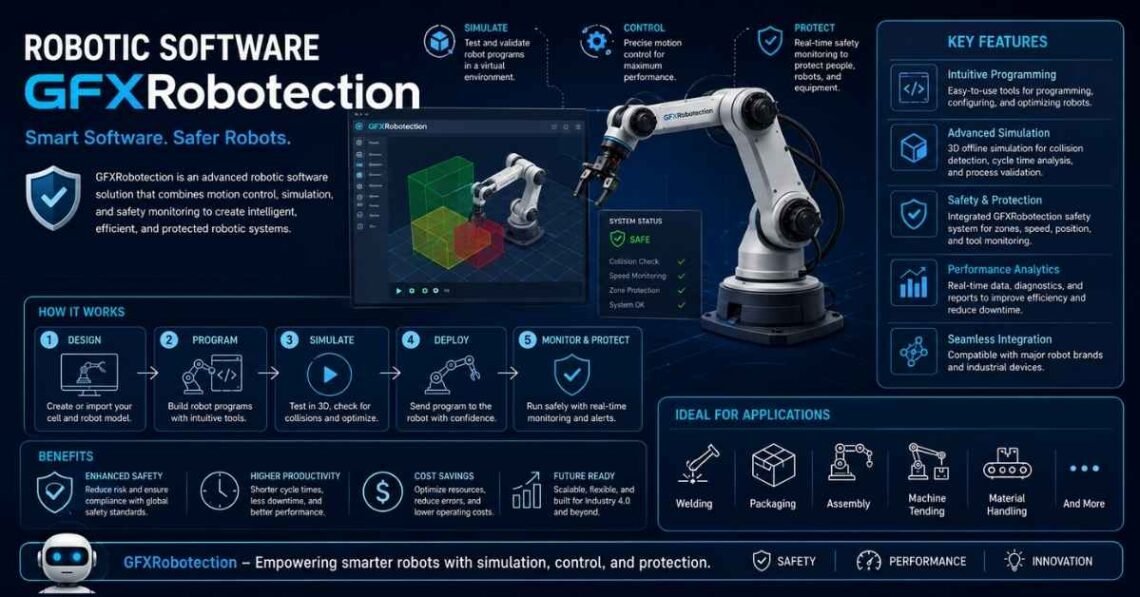
Automation is transforming the way we work, manufacture products, and solve complex problems. Robotic software GFXRobotection plays a major role in this transformation by providing the intelligence that allows robots to perform tasks accurately, efficiently, and with minimal human intervention. In simple terms, robotic software GFXRobotection refers to software systems that control, program, monitor, and optimize robotic machines for industrial, commercial, and personal applications.
Whether it’s a robotic arm assembling cars, a warehouse robot sorting packages, or a medical robot assisting during surgery, software serves as the brain behind every robotic system. This guide explains how robotic software works, its key features, benefits, applications, and why it has become essential in today’s technology-driven world.
What Is Robotic Software GFXRobotection?
Robotic software GFXRobotection refers to programs and digital platforms designed to operate, monitor, and manage robotic systems. Instead of manually controlling every movement, developers create software that allows robots to make decisions, follow instructions, process sensor data, and perform tasks with precision.
Modern robotic software combines several advanced technologies, including:
- Artificial Intelligence (AI)
- Machine Learning (ML)
- Computer Vision
- Motion Control
- Sensor Integration
- Automation Algorithms
- Cloud Computing
- Internet of Things (IoT)
Together, these technologies enable robots to operate efficiently in dynamic environments.
How Does Robotic Software Work?
Robotic software acts as the control center for a robot. It receives information from sensors, processes the data, makes decisions, and sends commands to motors or other hardware components.
The basic workflow includes:
- Collect data from cameras, sensors, or scanners.
- Analyze the information using software algorithms.
- Make decisions based on programmed instructions or AI models.
- Control robotic movements.
- Monitor performance and repeat the process continuously.
This cycle happens in real time, allowing robots to react quickly and accurately.
Core Components of Robotic Software
Several components work together to ensure smooth robot operation.
Motion Control System
Motion control software manages speed, direction, and positioning. It ensures that robotic arms and mobile robots move with high accuracy.
Artificial Intelligence Engine
AI enables robots to recognize objects, learn from data, and improve performance over time.
Computer Vision
Computer vision allows robots to “see” their surroundings using cameras and image-processing algorithms.
Common uses include:
- Object recognition
- Quality inspection
- Facial recognition
- Navigation
Sensor Integration
Robots rely on multiple sensors, including:
- Distance sensors
- Temperature sensors
- Pressure sensors
- GPS modules
- Infrared sensors
- LiDAR systems
The software processes this information to make informed decisions.
Key Features of Robotic Software GFXRobotection
Modern robotic software includes many advanced capabilities.
Intelligent Automation
Software automates repetitive tasks with minimal human supervision.
Real-Time Monitoring
Operators can track robot performance and system health through dashboards.
Remote Control
Cloud-based platforms allow users to monitor and control robots from almost anywhere.
Error Detection
Built-in diagnostics identify faults before they become major issues.
Data Analytics
Software collects operational data to improve efficiency and support predictive maintenance.
Benefits of Robotic Software
Businesses continue investing in robotic software because it offers measurable advantages.
Increased Productivity
Robots can perform repetitive tasks continuously without fatigue.
Higher Accuracy
Software-controlled robots reduce human error, leading to more consistent results.
Improved Workplace Safety
Robots handle dangerous or hazardous tasks, reducing risks for employees.
Lower Operating Costs
Although the initial investment may be significant, automation often lowers long-term labor and maintenance costs.
Better Quality Control
Robotic systems perform inspections with remarkable precision, improving product quality.
Applications of Robotic Software
Robotic software powers automation across many industries.
Manufacturing
Factories use robotic software for:
- Welding
- Assembly
- Packaging
- Painting
- Material handling
- Product inspection
Healthcare
Medical robots assist with:
- Robotic surgery
- Patient rehabilitation
- Pharmacy automation
- Laboratory testing
Logistics and Warehousing
Warehouse robots help businesses by:
- Picking products
- Sorting packages
- Managing inventory
- Moving goods efficiently
Agriculture
Farmers use robotic software for:
- Precision planting
- Crop monitoring
- Weed detection
- Automated harvesting
Retail
Retail businesses deploy robots for:
- Inventory tracking
- Customer assistance
- Shelf scanning
- Warehouse fulfillment
Robotic Software vs. Robotic Process Automation (RPA)
Although they sound similar, robotic software and Robotic Process Automation (RPA) serve different purposes.
| Feature | Robotic Software | Robotic Process Automation |
|---|---|---|
| Controls physical robots | Yes | No |
| Automates digital tasks | Limited | Yes |
| Uses sensors | Yes | No |
| Controls machinery | Yes | No |
| Primary use | Physical automation | Business process automation |
Understanding this difference helps organizations choose the right automation solution.
Challenges of Robotic Software
Despite its many benefits, robotic software also presents challenges.
Common limitations include:
- High implementation costs
- Complex system integration
- Cybersecurity risks
- Ongoing maintenance
- Software updates
- Skilled workforce requirements
Fortunately, ongoing technological advancements continue addressing many of these issues.
Future Trends in Robotic Software
The future of robotic software looks promising as technology continues to evolve.
Emerging trends include:
- AI-powered autonomous robots
- Collaborative robots (Cobots)
- Edge computing
- Digital twins
- 5G-enabled robotics
- Predictive maintenance
- Cloud robotics
- Human-robot collaboration
These innovations will make robots more intelligent, flexible, and accessible across industries.
LEARN MORE: Digital Craft GFXRobotection
Best Practices for Implementing Robotic Software
Organizations can maximize success by following these recommendations:
- Clearly define automation goals.
- Select software compatible with existing hardware.
- Prioritize cybersecurity measures.
- Train employees on system operation.
- Perform regular maintenance and updates.
- Monitor performance using analytics.
Following these practices helps ensure long-term efficiency and reliability.
Frequently Asked Questions
What is robotic software GFXRobotection?
Robotic software GFXRobotection refers to software platforms and applications that control, program, monitor, and optimize robotic systems using technologies such as AI, automation, and computer vision.
How does robotic software work?
It collects data from sensors, processes the information through algorithms, makes decisions, and sends commands that control robotic movements and actions.
What industries use robotic software?
Manufacturing, healthcare, agriculture, logistics, retail, construction, aerospace, and research organizations all rely on robotic software.
Is robotic software the same as RPA?
No. Robotic software controls physical robots, while Robotic Process Automation (RPA) automates repetitive digital tasks performed on computers.
Why is robotic software important?
It improves productivity, increases accuracy, enhances workplace safety, reduces operational costs, and enables intelligent automation across multiple industries.
Conclusion
Robotic software GFXRobotection has become the driving force behind today’s intelligent robotics. By combining artificial intelligence, sensor integration, computer vision, and automation technologies, it enables robots to perform complex tasks with speed, precision, and reliability.
As industries continue embracing automation, robotic software will play an even greater role in manufacturing, healthcare, logistics, agriculture, and many other sectors. Whether you’re exploring robotics for business or simply interested in emerging technology, understanding how robotic software works is an excellent first step toward staying ahead in an increasingly automated world.