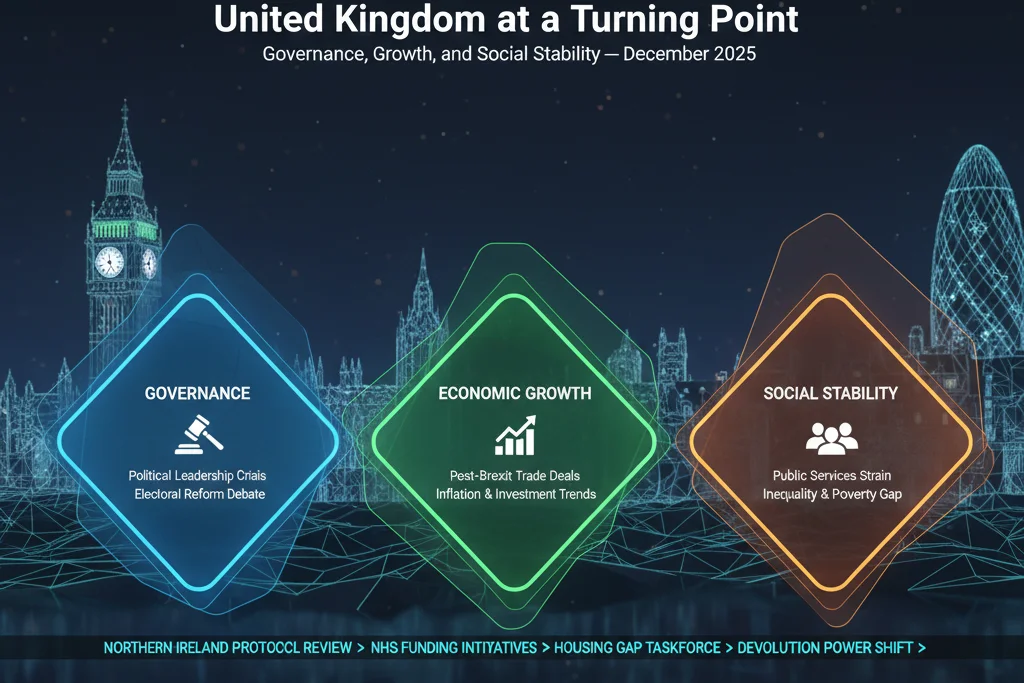
The United Kingdom is navigating a defining period marked by economic recalibration, evolving governance priorities, and shifting social dynamics. While political stability has improved following years of uncertainty, the nation continues to face complex challenges that require strategic planning, institutional resilience, and sustained public confidence. This national overview examines the key developments shaping the UK’s current trajectory across politics, the economy, public services, security, and international engagement.
Political Landscape and Governance
The UK’s political environment is currently characterised by an emphasis on stability, policy continuity, and accountable governance. Government leaders have prioritised restoring trust in public institutions by focusing on evidence-based decision-making and fiscal responsibility. Parliamentary debate has increasingly centred on delivery—measuring policy success not by intention, but by tangible outcomes.
Devolution remains a prominent issue within governance discussions. Regional and local authorities continue to advocate for greater control over funding and decision-making, particularly in areas such as transport, housing, and social care. Proponents argue that decentralisation enables more responsive and efficient service delivery, while critics caution that it may lead to uneven standards and accountability gaps across regions.
Public expectations of leadership remain high. Citizens increasingly demand transparency, fairness, and long-term solutions to persistent national issues rather than short-term political responses.
Economic Conditions and National Growth
Economic conditions in the United Kingdom present a mixed but stabilising outlook. Inflation has moderated compared to previous peaks, offering some relief to households and businesses. However, the cost of living remains a significant concern, with housing costs, energy prices, and essential goods continuing to place pressure on disposable incomes.
Interest rate adjustments have eased borrowing conditions, particularly for mortgage holders and businesses, yet consumer confidence remains cautious. Retail activity and private investment show uneven performance across sectors and regions, reflecting ongoing uncertainty about long-term growth prospects.
The government’s economic strategy has focused on improving productivity, encouraging innovation, and supporting high-growth sectors such as clean energy, advanced manufacturing, digital technology, and life sciences. Skills development and workforce participation are viewed as essential to addressing labour shortages and improving competitiveness.
Despite these efforts, regional economic disparities remain a challenge. Addressing uneven growth across the country continues to be a central policy objective.
Public Services and Infrastructure Capacity
Public services remain under sustained strain, driven by rising demand, demographic change, and long-standing capacity constraints. The National Health Service continues to face workforce shortages, high patient volumes, and extended waiting times. While additional funding has been allocated, healthcare leaders emphasise that meaningful improvement depends on long-term workforce planning, operational reform, and infrastructure investment.
Education systems across the UK face similar pressures. Schools and colleges report difficulties in recruiting and retaining staff, alongside growing responsibilities related to student wellbeing and special educational needs. Higher education institutions are navigating financial uncertainty, prompting ongoing debate around funding models, research investment, and international student policy.
Local councils, responsible for delivering many frontline services, continue to operate under tight budgetary conditions. Social care, housing support, and community services remain particularly affected, with implications for both social outcomes and economic participation.
Social Climate and Community Cohesion
Social cohesion remains a central issue in national discourse. Immigration, inequality, and regional imbalance continue to shape public debate and political engagement. Increased civic participation and public demonstrations reflect heightened awareness of national issues, but also underscore divisions in opinion.
Community leaders and civil society organisations have emphasised the importance of inclusive dialogue, fair policy implementation, and consistent enforcement of the law. Efforts to address hate crime, promote integration, and support vulnerable groups have gained greater prominence at both national and local levels.
Public confidence in institutions is closely linked to perceptions of opportunity and fairness. Access to affordable housing, stable employment, and quality public services remains a key determinant of social trust, particularly among younger generations.
Security, Defence, and Digital Resilience
Security considerations in the UK have expanded beyond traditional defence priorities. Cybersecurity has emerged as a critical national issue as digital systems underpin essential services, government operations, and financial infrastructure. Recent incidents have highlighted vulnerabilities and reinforced the need for stronger cyber resilience across public and private sectors.
The government has increased its focus on digital security standards, inter-agency coordination, and workforce capability in cyber defence. Businesses are also being encouraged to strengthen their digital protections, recognising the broader economic and national security implications.
Defence policy continues to emphasise readiness, modernisation, and international cooperation. While the UK remains committed to its alliances and global security responsibilities, defence procurement efficiency and long-term capability planning remain under review.
International Relations and Strategic Positioning
On the international stage, the United Kingdom continues to balance diplomatic influence, economic interests, and security commitments. Strengthening relationships with long-standing allies remains a cornerstone of foreign policy, alongside efforts to expand trade and diplomatic engagement with emerging markets.
Trade diversification, climate cooperation, and global security challenges feature prominently in international discussions. The UK’s foreign policy approach increasingly reflects the need to align international ambition with domestic economic capacity and institutional strength.
Global uncertainty has reinforced the importance of consistency and credibility in Britain’s international engagement.
Environment, Energy, and Sustainability
Environmental policy remains integral to the UK’s long-term strategy. Investments in renewable energy, nuclear development, and energy efficiency are positioned as both environmental necessities and economic opportunities. These initiatives aim to enhance energy security while supporting job creation and industrial growth.
However, progress toward climate targets remains uneven. Infrastructure delays, regulatory complexity, and funding constraints continue to challenge implementation. Analysts stress that sustained commitment, clear policy frameworks, and public-private collaboration will be essential to achieving long-term sustainability goals.
Conclusion
The United Kingdom today stands at a point of cautious consolidation. Economic recovery, public service reform, social cohesion, and international engagement are deeply interconnected challenges that require coordinated and long-term responses. Stability alone will not be sufficient; progress will depend on the ability to translate policy objectives into measurable improvements in people’s daily lives.
As the UK moves forward, the effectiveness of governance, the inclusiveness of growth, and the resilience of institutions will determine the nation’s capacity to adapt to change and maintain confidence at home and abroad.