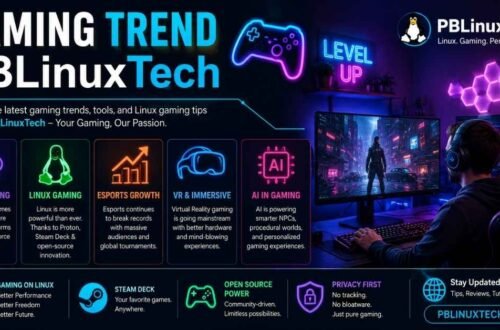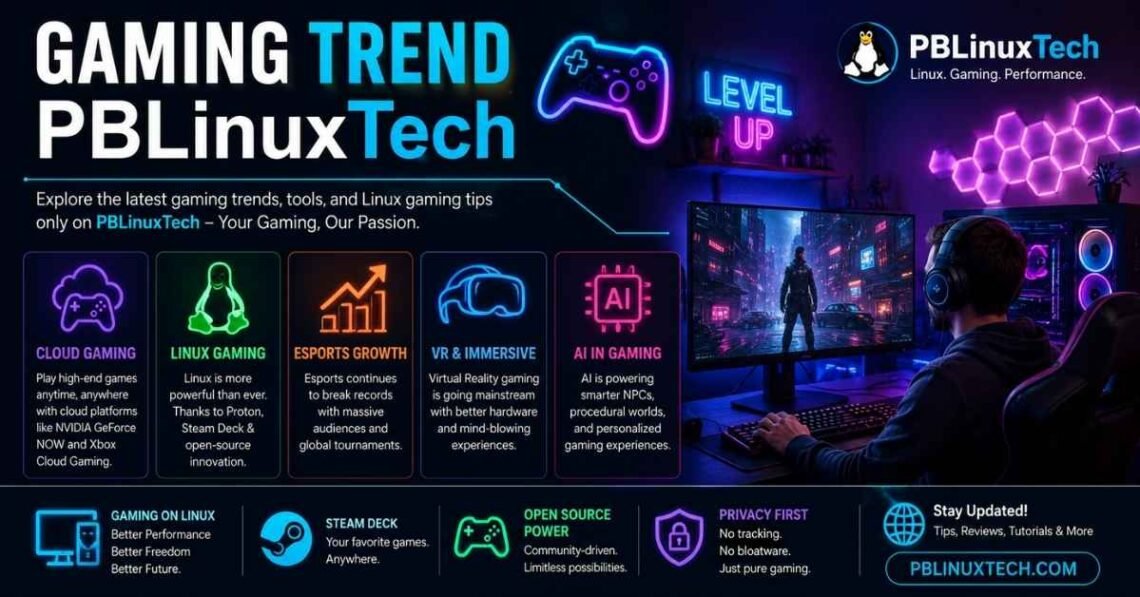
Gaming trend PBLinuxTech is a growing topic that highlights how Linux gaming, Steam Deck, artificial intelligence (AI), cloud gaming, performance optimization, and modern gaming technologies are reshaping the future of PC gaming. Rather than simply reporting gaming news, Gaming Trend PBLinuxTech focuses on explaining which trends matter, why they matter, and how gamers can benefit from them. Whether you’re a casual player, a Linux enthusiast, a competitive gamer, or someone planning a hardware upgrade, understanding these trends helps you make smarter decisions and stay ahead of rapid industry changes.
The latest trends PBLinuxTech covers include the rise of Steam Proton, Vulkan, DXVK, AMD FSR, NVIDIA DLSS, Intel XeSS, Unreal Engine 5, Steam Deck, cloud gaming, open-source gaming, and AI-powered game development. Instead of chasing every new technology, this guide helps you understand which innovations are truly changing gaming and which are simply temporary hype.
What Is Gaming Trend PBLinuxTech?
Gaming Trend PBLinuxTech refers to technology-focused coverage that explores the latest developments shaping modern gaming. It combines gaming news, Linux gaming improvements, hardware innovations, graphics technologies, software optimization, and future gaming predictions into one easy-to-understand resource.
Unlike general gaming news websites that focus mainly on announcements, Gaming Trend PBLinuxTech explains:
- Why gaming technologies are changing
- How Linux gaming is improving
- Which hardware upgrades matter
- How AI influences gaming
- What gamers should prepare for next
This practical approach helps readers understand technology rather than simply follow headlines.
Why Gaming Trends Matter More Than Ever
Gaming evolves much faster today than it did a decade ago.
Every year introduces:
- New graphics technologies
- Better hardware
- Faster storage
- AI-powered features
- Cloud gaming services
- Cross-platform gaming
- Portable gaming devices
Following trusted gaming trends helps players invest wisely instead of upgrading based on marketing hype.
Make Better Gaming Decisions
Understanding trends helps you decide:
- Whether it’s time to upgrade your GPU.
- If Linux is ready for your favorite games.
- Whether a Steam Deck fits your gaming style.
- Which technologies will remain relevant for years.
Avoid Costly Mistakes
Many gamers spend money on unnecessary upgrades because they don’t understand where gaming technology is heading.
Learning industry trends reduces that risk.
Major Trends PBLinuxTech Covers
The platform explores a broad range of gaming technologies rather than focusing on one niche.
| Gaming Trend | Why It Matters | Best For |
|---|---|---|
| Linux Gaming | Expanding compatibility and performance | PC gamers |
| Steam Deck | Portable Linux gaming | Mobile gamers |
| Artificial Intelligence | Smarter gameplay and optimization | All gamers |
| Cloud Gaming | Gaming without expensive hardware | Casual players |
| Cross-Platform Gaming | Play with friends across devices | Multiplayer gamers |
| Open-Source Gaming | Community-driven innovation | Linux users |
| Gaming Hardware | Better performance | Enthusiasts |
| Graphics Technologies | Improved visuals and FPS | Competitive players |
These trends PBLinuxTech highlights influence nearly every part of the gaming ecosystem.
Linux Gaming: The Biggest Trend PBLinuxTech Highlights
Few gaming trends have grown as rapidly as Linux gaming.
Thanks to major investments from Valve, Linux has become a realistic gaming platform for many players.
Native Linux Games
Many developers now publish games with native Linux support.
Advantages include:
- Better stability
- Improved optimization
- Direct Vulkan support
- Lower compatibility issues
Although native Linux games still represent a smaller percentage of the market, support continues improving.
Steam Proton
Steam Proton has transformed Linux gaming by allowing thousands of Windows games to run on Linux.
Benefits include:
- Larger game library
- Improved compatibility
- Frequent updates
- Better graphics performance
Proton GE
Some games work better using Proton GE, which includes additional compatibility fixes beyond the standard Proton release.
Experienced Linux gamers often test multiple Proton versions for the best performance.
Wine Compatibility
Wine remains essential for running many Windows applications and older games.
Together, Wine and Proton have dramatically expanded Linux gaming possibilities.
ProtonDB
Before purchasing a game, many players check ProtonDB.
Community reports often reveal:
- Performance
- Compatibility
- Known bugs
- Recommended Proton versions
SteamOS
Valve’s SteamOS has accelerated Linux gaming adoption through the popularity of the Steam Deck.
This trend is expected to continue as handheld gaming grows.
Gaming Technologies Changing the Industry
Modern gaming depends on far more than powerful graphics cards.
Several technologies now shape both performance and visual quality.
Vulkan
Vulkan has become one of the most important graphics APIs for Linux gaming.
Its advantages include:
- Lower CPU overhead
- Better multi-core utilization
- Cross-platform compatibility
- Improved rendering efficiency
DirectX 12
Many Windows games use DirectX 12.
Linux users rely on technologies like:
- DXVK
- VKD3D-Proton
to translate DirectX calls into Vulkan.
Unreal Engine 5
Unreal Engine 5 introduces:
- Nanite virtualized geometry
- Lumen lighting
- Higher-quality assets
- Improved physics
Many upcoming AAA games use Unreal Engine 5.
Unity
Unity remains one of the most popular engines for indie developers.
It powers thousands of games across multiple platforms.
Ray Tracing
Ray Tracing improves:
- Lighting
- Reflections
- Shadows
- Overall realism
Although demanding, newer GPUs increasingly support this technology.
NVIDIA DLSS
Deep Learning Super Sampling (DLSS) uses AI to improve frame rates while maintaining image quality.
Benefits include:
- Higher FPS
- Better visual fidelity
- Lower GPU workload
AMD FSR
AMD FidelityFX Super Resolution (FSR) offers similar performance improvements across a wider range of hardware.
Intel XeSS
Intel XeSS is another AI-based upscaling technology helping gamers enjoy smoother gameplay.
Hardware Trends Every Gamer Should Understand
Hardware continues evolving alongside software.
Understanding upgrade priorities saves money.
Graphics Cards
Modern gaming benefits from GPUs supporting:
- Ray Tracing
- DLSS
- AMD FSR
- Vulkan
Popular choices include:
- NVIDIA GeForce RTX
- AMD Radeon RX
Processors
Gaming increasingly benefits from higher core counts.
Recommended CPUs include:
- Intel Core i5
- Intel Core i7
- AMD Ryzen 5
- AMD Ryzen 7
Storage
Modern games often exceed 100 GB.
Installing games on an NVMe SSD provides:
- Faster loading
- Better streaming performance
- Reduced texture pop-in
- Quicker updates
Memory
General recommendations:
| RAM | Best For |
|---|---|
| 8 GB | Casual gaming |
| 16 GB | Recommended |
| 32 GB | Streaming and content creation |
Portable Gaming
Portable gaming continues expanding through devices like the Steam Deck, making Linux gaming more accessible than ever.
Steam Deck and the Handheld Gaming Revolution
The Steam Deck represents one of the most important gaming trends of recent years.
Running SteamOS, it combines Linux with portable PC gaming.
Why Steam Deck Is Growing
Players appreciate:
- Portable gaming
- Massive Steam library
- Proton compatibility
- Continuous software improvements
Steam Deck Verification
Games receive one of four compatibility ratings:
- Verified
- Playable
- Unsupported
- Unknown
Checking compatibility before purchasing helps avoid disappointment.
Battery Optimization
Gamers often improve battery life by:
- Limiting FPS
- Lowering brightness
- Reducing background activity
- Adjusting graphics settings
These small optimizations significantly extend portable play sessions.
Trend PBLinuxTech: How AI Is Transforming Gaming
One of the fastest-growing trend PBLinuxTech covers is the influence of Artificial Intelligence.
AI is changing gaming far beyond graphics.
Today it helps developers with:
- Smarter NPC behavior
- Procedural world generation
- Dynamic difficulty
- Personalized gameplay
- Performance optimization
- Accessibility improvements
Rather than replacing creativity, AI increasingly assists developers in building larger, more responsive game worlds.
Expert Insight: The biggest gaming trends aren’t always the ones with the loudest marketing campaigns. Technologies like Steam Proton, Vulkan, Open Source, and AI-assisted optimization have quietly transformed the gaming experience by improving compatibility, performance, and accessibility across a wide range of hardware.
Practical Linux Gaming Optimization
Understanding gaming trends is useful, but applying them to your own system is what delivers real benefits. A well-optimized Linux setup can improve FPS, reduce input latency, shorten loading times, and minimize stuttering.
Update Graphics Drivers
Always install the latest drivers for your hardware.
Recommended options include:
- NVIDIA Proprietary Drivers
- AMD Mesa Drivers
- Intel Graphics Drivers
Updated drivers often improve game compatibility and stability.
Install the Latest Proton Version
Before launching a new Windows game on Linux, make sure you’re using:
- Proton Stable
- Proton Experimental
- Proton GE (when additional fixes are needed)
Different Proton versions can produce noticeably different results.
Enable GameMode
GameMode automatically optimizes system resources while gaming by adjusting CPU scheduling and performance settings.
Monitor Performance with MangoHud
MangoHud displays useful real-time information, including:
- FPS
- CPU usage
- GPU usage
- VRAM
- RAM
- Temperature
These metrics help identify performance bottlenecks.
Enable Shader Pre-Caching
Shader pre-caching reduces:
- Micro-stuttering
- Long shader compilation times
- Frame pacing issues
Verify Vulkan Support
Modern Linux gaming depends heavily on Vulkan. Confirm that your GPU and drivers fully support it before installing demanding titles.
Linux Gaming Optimization Checklist
- Update graphics drivers.
- Install the latest Proton version.
- Enable GameMode.
- Use MangoHud for monitoring.
- Verify Vulkan support.
- Keep Steam and SteamOS updated.
- Install games on an NVMe SSD whenever possible.
Cloud Gaming vs Local Gaming
Cloud gaming continues to evolve, but it doesn’t replace local gaming for everyone.
| Feature | Cloud Gaming | Local Gaming |
|---|---|---|
| Hardware Cost | Lower | Higher |
| Performance Control | Limited | Full |
| Internet Required | Yes | No (after installation) |
| Graphics Quality | Depends on connection | Depends on hardware |
| Offline Play | Usually unavailable | Available |
When Cloud Gaming Makes Sense
Cloud gaming works well for:
- Casual players
- Travelers
- Users without powerful gaming PCs
- Testing new games before upgrading hardware
When Local Gaming Is Better
Local gaming remains the preferred option for:
- Competitive players
- High refresh-rate gaming
- Modding
- Maximum graphics quality
- Consistent low latency
Which Gaming Trends Actually Matter?
Not every gaming trend becomes a lasting innovation. Focusing on technologies with real-world value helps you make smarter decisions.
| Trend | Current Value | Long-Term Outlook |
|---|---|---|
| Linux Gaming | High | Excellent |
| Steam Deck | High | Strong |
| Artificial Intelligence | High | Excellent |
| Cloud Gaming | Medium | Growing |
| Ray Tracing | High | Strong |
| DLSS / AMD FSR / Intel XeSS | High | Excellent |
| Metaverse Gaming | Low | Uncertain |
Rather than chasing every headline, prioritize technologies that improve compatibility, performance, and long-term usability.
Preparing Your Gaming Setup for Future Trends
Future-proofing your gaming system doesn’t always require buying the latest hardware.
Upgrade Priorities
Focus on upgrades that deliver noticeable improvements:
- NVMe SSD
- Modern GPU
- 16–32 GB RAM
- Current multi-core CPU
- Reliable cooling
Keep Software Updated
Regularly update:
- Steam
- SteamOS
- Proton
- Graphics drivers
- Linux packages
Small software updates often solve performance issues without new hardware.
Plan Before Buying
Before investing in new components, ask:
- Does my current hardware meet recommended requirements?
- Will the upgrade improve my favorite games?
- Is Linux compatibility important?
- Can I wait for the next hardware generation?
Common Mistakes Gamers Make
Following trends without understanding them often leads to wasted money and frustration.
Upgrading Too Early
Buying hardware immediately after launch isn’t always necessary.
Waiting a few months often provides:
- Better pricing
- Improved drivers
- More reliable reviews
Ignoring Driver Updates
Even powerful hardware performs poorly with outdated drivers.
Following Every Trend
Not every technology deserves your attention.
Prioritize trends that provide measurable improvements.
Trusting Rumors
Always verify gaming news using official developer announcements and trusted sources.
Ignoring Linux Compatibility
Linux users should check:
- ProtonDB
- Steam Deck verification
- Official developer support
before purchasing new games.
Gaming Trend PBLinuxTech vs Other Gaming Resources
| Website | Linux Gaming | Steam Deck | Hardware | AI Coverage | Optimization Guides | Beginner Friendly |
|---|---|---|---|---|---|---|
| Gaming Trend PBLinuxTech | ⭐⭐⭐⭐⭐ | ⭐⭐⭐⭐⭐ | ⭐⭐⭐⭐☆ | ⭐⭐⭐⭐☆ | ⭐⭐⭐⭐⭐ | ⭐⭐⭐⭐⭐ |
| GamingOnLinux | ⭐⭐⭐⭐⭐ | ⭐⭐⭐⭐⭐ | ⭐⭐⭐☆☆ | ⭐⭐☆☆☆ | ⭐⭐⭐⭐☆ | ⭐⭐⭐⭐☆ |
| PC Gamer | ⭐⭐☆☆☆ | ⭐⭐⭐☆☆ | ⭐⭐⭐⭐☆ | ⭐⭐⭐☆☆ | ⭐⭐⭐☆☆ | ⭐⭐⭐⭐☆ |
| IGN | ⭐☆☆☆☆ | ⭐⭐☆☆☆ | ⭐⭐⭐☆☆ | ⭐⭐☆☆☆ | ⭐⭐☆☆☆ | ⭐⭐⭐⭐☆ |
| GameSpot | ⭐☆☆☆☆ | ⭐⭐☆☆☆ | ⭐⭐⭐☆☆ | ⭐⭐☆☆☆ | ⭐⭐☆☆☆ | ⭐⭐⭐⭐☆ |
Readers interested in Linux gaming, optimization, and emerging technologies may find specialized coverage more relevant than general gaming news alone.
Expert Recommendations for Different Types of Gamers
Beginners
Start by learning:
- Linux basics
- Steam
- Proton
- Vulkan
- Basic optimization techniques
Linux Enthusiasts
Explore:
- Proton GE
- Mesa updates
- DXVK
- VKD3D-Proton
- GameMode
- MangoHud
Competitive Gamers
Prioritize:
- High refresh-rate displays
- Low latency
- Updated drivers
- Stable frame rates
- Network optimization
Steam Deck Owners
Regularly:
- Update SteamOS
- Test newer Proton versions
- Check game verification status
- Adjust battery and performance profiles
LEARN MORE: Video Game News PBLinuxTech
Essential Gaming Terms Explained
| Term | Meaning |
|---|---|
| SteamOS | Linux-based operating system for Steam Deck |
| Proton | Compatibility layer for Windows games on Linux |
| ProtonDB | Community database of Linux game compatibility |
| Vulkan | Modern graphics API optimized for performance |
| DXVK | DirectX-to-Vulkan translation layer |
| Ray Tracing | Advanced lighting technology |
| DLSS | NVIDIA AI-powered upscaling |
| AMD FSR | AMD image upscaling technology |
| Intel XeSS | Intel AI-assisted upscaling |
| Shader Cache | Precompiled graphics data that reduces stuttering |
Understanding these technologies makes it easier to follow gaming trend PBLinuxTech and evaluate future developments.
Frequently Asked Questions
What is Gaming Trend PBLinuxTech?
Gaming Trend PBLinuxTech is a technology-focused resource covering Linux gaming, Steam Deck, AI, gaming hardware, graphics technologies, performance optimization, and emerging gaming trends.
Why is Linux gaming becoming more popular?
Improvements in Steam Proton, SteamOS, Vulkan, and community-driven open-source projects have significantly expanded Linux game compatibility and performance.
Is Steam Deck changing PC gaming?
Yes. Steam Deck has introduced many players to Linux gaming while encouraging developers to improve compatibility across platforms.
Which gaming trend should beginners follow first?
Focus on practical trends such as Linux gaming improvements, graphics driver updates, and performance optimization before exploring more experimental technologies.
Should I upgrade my GPU now?
That depends on your current hardware, the games you play, and whether your existing system already meets recommended requirements. Performance improvements from software updates alone can sometimes postpone the need for a hardware upgrade.
Final Thoughts
Gaming trend PBLinuxTech reflects much more than the latest headlines. It highlights the technologies shaping the future of gaming, including Linux gaming, Steam Deck, SteamOS, Proton, Vulkan, AI, cloud gaming, graphics innovations, and performance optimization. By understanding these developments, gamers can make informed decisions about hardware upgrades, software choices, and long-term gaming strategies.
Instead of following every new trend, focus on those that deliver measurable value. Technologies like Proton, Vulkan, DLSS, AMD FSR, Intel XeSS, and open-source gaming tools continue to improve accessibility, compatibility, and performance for millions of players.
Key Takeaway: The best way to stay ahead isn’t to chase every trend—it’s to understand which innovations solve real problems. Following trusted resources, maintaining your gaming system, and evaluating new technologies with a practical mindset will help you enjoy a smoother and more future-ready gaming experience.