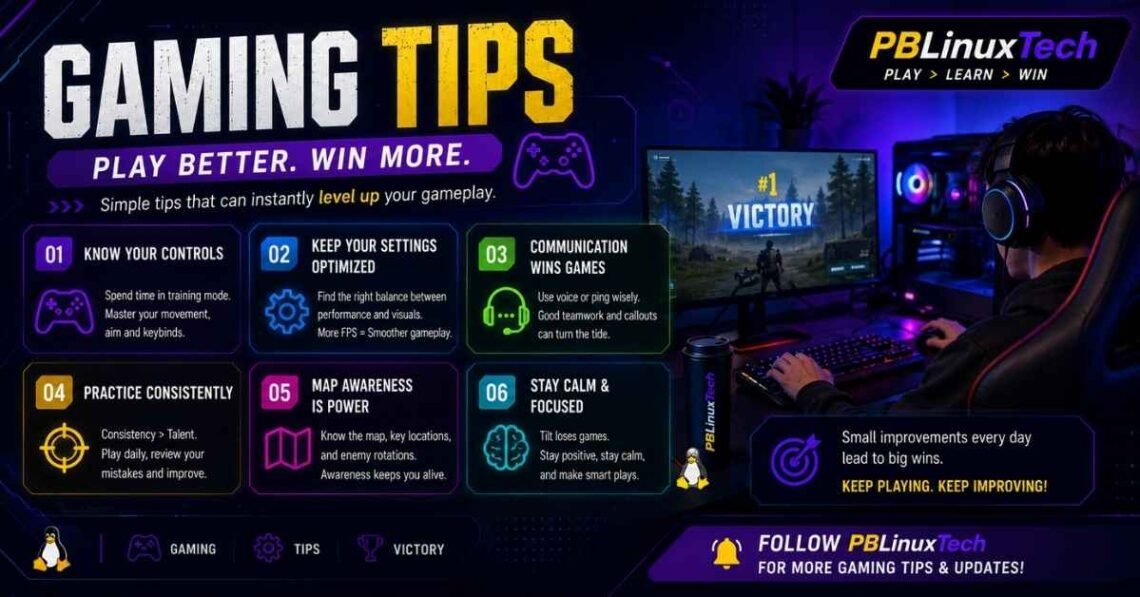
Gaming tips pblinuxtech help gamers improve their overall gaming experience by combining practical gameplay strategies with Linux gaming optimization, performance tweaks, and the right gaming tools. Whether you’re new to Linux gaming or looking to get more FPS, reduce input lag, or play Windows games using Proton and Steam Play, following proven techniques can make a noticeable difference. This guide covers everything from optimizing your gaming setup to improving your in-game skills, making it a complete resource for beginners and experienced players alike.
Gaming on Linux has evolved rapidly over the past few years. Thanks to tools like Steam, Proton, Lutris, Heroic Games Launcher, GameMode, MangoHud, and Gamescope, Linux users can now enjoy thousands of games with excellent compatibility and performance. The key is knowing how to configure your system and develop good gaming habits.
What Is Gaming Tips PBLinuxTech?
Gaming Tips PBLinuxTech refers to a collection of practical recommendations designed to help gamers get the best performance from Linux-based gaming systems. Instead of focusing only on hardware, these tips combine software optimization, graphics settings, compatibility tools, gameplay improvement, and system maintenance.
Unlike many generic gaming guides, the goal is to help players:
- Improve game performance
- Increase FPS
- Reduce lag and stuttering
- Optimize Linux for gaming
- Build better gaming skills
- Enjoy smoother gameplay across different genres
Whether you play AAA games, indie titles, competitive shooters, or strategy games, these techniques can improve both performance and consistency.
Why Gaming Performance Matters More Than Ever
Modern games are far more demanding than they were a few years ago. High-resolution textures, advanced lighting, and real-time physics require a well-optimized system.
Poor performance often leads to:
| Issue | Effect on Gameplay |
|---|---|
| Low FPS | Choppy movement |
| High Input Lag | Slower reactions |
| Screen Tearing | Distracting visuals |
| High Ping | Delayed actions |
| Stuttering | Inconsistent gameplay |
| Outdated Drivers | Crashes and poor performance |
Even players with expensive hardware can experience these issues if their systems aren’t configured correctly.
“A well-optimized mid-range PC often delivers a better gaming experience than a high-end system with poor configuration.”
Essential Gaming Tips PBLinuxTech Recommends
Improving your gaming experience doesn’t always require new hardware. Small adjustments often deliver significant improvements.
Optimize Your Graphics Settings
Many gamers automatically choose Ultra settings without considering performance.
Instead:
- Use 1080p or 1440p resolution depending on your GPU.
- Lower Shadow Quality before reducing textures.
- Disable Motion Blur.
- Reduce unnecessary visual effects.
- Enable FSR, DLSS, or XeSS if supported.
These changes can dramatically increase FPS while maintaining excellent visual quality.
Maintain a Stable Frame Rate
A stable 60 FPS, 120 FPS, or 144 FPS usually feels smoother than constantly fluctuating frame rates.
Use tools like:
- MangoHud
- Steam FPS Counter
- Gamescope
- Built-in benchmarking tools
Monitoring 1% Low FPS and 0.1% Low FPS helps identify stuttering that average FPS numbers may hide.
Reduce Input Lag
Input lag affects reaction time, especially in competitive games.
To minimize it:
- Enable GameMode
- Use wired peripherals when possible
- Disable unnecessary overlays
- Close background applications
- Enable your monitor’s gaming mode
Lower input latency improves aiming, movement, and overall responsiveness.
Lower Network Latency
A powerful PC cannot compensate for poor internet quality.
For online games:
- Use an Ethernet connection.
- Avoid large downloads while gaming.
- Restart your router regularly.
- Select the nearest game server.
- Monitor your Ping and Latency.
Maintaining latency below 50 ms generally provides a smoother multiplayer experience.
Keep Drivers and Software Updated
Updated software often brings:
- Better game compatibility
- Improved Vulkan support
- Performance improvements
- Bug fixes
- Security updates
Update regularly:
- Mesa
- NVIDIA Drivers
- AMD Drivers
- Linux Kernel
- Proton
- Steam
Close Background Applications
Applications consuming CPU or RAM reduce gaming performance.
Before launching a game:
- Close browsers with multiple tabs.
- Stop unnecessary startup programs.
- Disable heavy synchronization software.
- Pause large downloads.
This frees valuable system resources.
Linux Gaming Optimization Tips
Linux has become one of the best platforms for PC gaming when configured correctly.
Install Steam and Steam Play
Steam remains the most popular gaming platform for Linux.
Steam Play allows Linux users to launch thousands of Windows games through Proton, making game compatibility much better than it was in the past.
Benefits include:
- Easy installation
- Automatic updates
- Cloud Saves
- Achievements
- Controller support
Use Proton for Windows Games
Proton is a compatibility layer developed by Valve.
It allows many Windows games to run directly on Linux without complex setup.
For the best compatibility:
- Use the latest stable Proton release.
- Try Proton Experimental for newer games.
- Check compatibility ratings before installation.
Many DirectX 11 and DirectX 12 games now perform impressively using DXVK and VKD3D-Proton.
Configure Lutris
Some games are unavailable through Steam.
That’s where Lutris becomes valuable.
It supports:
- Epic Games Store
- GOG
- Ubisoft Connect
- EA App
- Battle.net
Lutris automatically manages Wine versions, launch scripts, and compatibility settings, simplifying game installation.
Monitor Performance with MangoHud
MangoHud is one of the most useful Linux gaming tools.
It displays real-time statistics, including:
| Performance Metric | Purpose |
|---|---|
| FPS | Frame rate monitoring |
| GPU Usage | Graphics workload |
| CPU Usage | Processor performance |
| VRAM Usage | Graphics memory |
| RAM Usage | System memory |
| Frame Time | Detect stuttering |
| Temperature | Hardware health |
Monitoring these values helps identify bottlenecks before they become serious problems.
Boost Performance Using GameMode
GameMode automatically optimizes Linux while you play.
It can:
- Adjust the CPU Governor
- Prioritize gaming processes
- Improve responsiveness
- Reduce background interference
For many systems, GameMode provides smoother gameplay without requiring manual tuning.
Improve Full-Screen Performance with Gamescope
Gamescope is especially useful for:
- Steam Deck
- AMD Radeon GPUs
- Intel Arc Graphics
- NVIDIA GeForce RTX systems
It helps manage:
- Scaling
- Resolution
- Frame pacing
- Full-screen rendering
Gamescope also reduces screen tearing in supported games.
Choose the Right Graphics Drivers
Graphics drivers directly affect gaming performance.
General recommendations include:
| GPU | Recommended Driver |
|---|---|
| AMD Radeon RX | Mesa RADV |
| NVIDIA GeForce RTX | Official NVIDIA Driver |
| Intel Arc | Latest Mesa Driver |
Keeping drivers current often results in higher FPS, better Vulkan performance, and improved compatibility with newer games.
Enable Vulkan for Better Performance
Vulkan has become the preferred graphics API for many Linux games.
Compared with older rendering methods like OpenGL, Vulkan generally provides:
- Lower CPU overhead
- Better multi-core utilization
- Higher frame rates
- Reduced stuttering
- Improved GPU efficiency
Many modern games running through DXVK or VKD3D-Proton benefit significantly from Vulkan, especially on AMD Ryzen, Intel Core, AMD Radeon RX, and NVIDIA GeForce RTX hardware.
Best Linux Distributions for Gaming
Choosing the right Linux distribution can improve both compatibility and ease of use.
| Distribution | Best For | Highlights |
|---|---|---|
| Ubuntu | Beginners | Excellent software support and large community |
| Fedora | Developers & Enthusiasts | Up-to-date packages and strong performance |
| Pop!_OS | NVIDIA Users | Built-in GPU support and gaming-friendly features |
| Nobara Linux | Gamers | Preconfigured gaming optimizations |
| Bazzite | Console-like Experience | Steam-focused interface |
| SteamOS | Steam Deck Users | Optimized for handheld gaming |
The best choice depends on your experience level, hardware, and the types of games you play. For most beginners, Ubuntu and Pop!_OS provide an excellent balance of stability and compatibility, while Nobara Linux and SteamOS are ideal for users who want gaming-focused optimizations with minimal setup.
Hardware Tips to Improve Gaming Performance
Powerful hardware certainly helps, but balanced components are far more important than simply buying the most expensive parts. A system with the right combination of CPU, GPU, memory, and storage delivers a smoother gaming experience.
CPU Considerations
Modern games benefit from multi-core processors. An AMD Ryzen or Intel Core processor with 6-core or 8-core performance is ideal for most gamers. Competitive titles often rely on strong single-core performance, while open-world and simulation games make better use of multiple cores.
GPU Selection
Your graphics card has the biggest impact on gaming performance.
| GPU Type | Best For |
|---|---|
| AMD Radeon RX | Excellent Vulkan performance and Linux compatibility |
| NVIDIA GeForce RTX | Ray Tracing, DLSS, and high-end gaming |
| Intel Arc | Budget gaming with improving Linux driver support |
RAM Recommendations
Memory affects loading times and multitasking.
| Gaming Level | Recommended RAM |
|---|---|
| Casual Gaming | 8 GB RAM |
| Modern Gaming | 16 GB RAM |
| Streaming & Content Creation | 32 GB RAM |
| Professional Workloads | 64 GB RAM |
SSD vs HDD
Installing games on an SSD or NVMe SSD significantly reduces loading times compared to a traditional hard drive.
| Storage | Benefit |
|---|---|
| 256 GB SSD | Entry-level gaming |
| 512 GB SSD | Good balance |
| 1 TB SSD | Ideal for most gamers |
| 2 TB SSD | Large game libraries |
Gaming Monitor and Peripherals
A 144 Hz monitor paired with a responsive gaming mouse, mechanical keyboard, or controller improves responsiveness. While hardware won’t automatically make you a better player, it removes unnecessary limitations.
Graphics Settings That Improve FPS Without Sacrificing Quality
Many players lower every graphics option when chasing higher FPS. A smarter approach is to adjust the settings that impact performance the most.
| Graphics Setting | Recommended Adjustment |
|---|---|
| Resolution | Use 1080p or 1440p |
| Texture Quality | High (if VRAM allows) |
| Shadow Quality | Medium |
| Anti-Aliasing | Medium |
| Motion Blur | Off |
| Ray Tracing | Enable only if performance remains stable |
| V-Sync | Off for competitive gaming |
If your game supports FSR, DLSS, or XeSS, enabling these technologies can improve frame rates while maintaining image quality.
Improve Your Gaming Skills Beyond Hardware
Even a perfectly optimized Linux system cannot replace good gameplay habits.
Build Better Aim
Aim improves through consistent practice rather than random matches. Spend time warming up before competitive sessions and focus on accuracy instead of speed.
Improve Positioning
Good positioning allows you to survive longer, control engagements, and create better opportunities. Study maps, understand common routes, and avoid predictable movement.
Learn Map Awareness
Skilled players constantly monitor objectives, teammate locations, and enemy movements. Developing strong map awareness often has a greater impact than raw mechanical skill.
Develop Better Decision-Making
Winning players know when to fight, when to retreat, and when to reposition. Reviewing your own matches can reveal mistakes that are easy to overlook during gameplay.
Improve Team Communication
In multiplayer games, clear communication leads to better coordination. Share useful information, call out enemy positions, and avoid unnecessary distractions.
Learn From Professional Players
Watching experienced players isn’t about copying every move. Instead, observe how they manage positioning, resource usage, and decision-making under pressure.
Daily Habits That Help You Become a Better Gamer
Improvement comes from consistency rather than marathon gaming sessions.
A simple daily routine can include:
- Warm up for 15–20 minutes.
- Review one previous match.
- Practice one specific skill.
- Play focused competitive games.
- Take regular breaks to avoid fatigue.
Healthy habits such as proper sleep, hydration, and maintaining good posture also improve reaction time and concentration.
“Small improvements repeated every day lead to significant progress over time.”
Internet Optimization for Smoother Online Gaming
Fast internet alone doesn’t guarantee a smooth online experience.
To reduce lag:
- Use an Ethernet connection instead of Wi-Fi whenever possible.
- Keep ping below 50 ms for competitive games.
- Restart your router periodically.
- Avoid large downloads during gaming sessions.
- Choose the closest available game server.
- Configure reliable DNS settings if recommended by your ISP.
These simple adjustments help reduce packet loss and maintain a stable connection.
Common Linux Gaming Problems and Their Solutions
| Problem | Possible Solution |
|---|---|
| Low FPS | Update GPU drivers, enable GameMode, optimize graphics settings |
| Game Crashes | Check Proton version or Wine configuration |
| Black Screen | Update Mesa or NVIDIA drivers |
| Audio Issues | Verify PipeWire settings |
| Controller Not Working | Enable Steam Input or reconnect the controller |
| Shader Stuttering | Allow shader cache to build |
| Compatibility Problems | Check ProtonDB ratings before launching the game |
Most issues can be resolved through updated drivers, correct compatibility tools, or minor configuration changes.
Best Linux Gaming Tools Every Gamer Should Use
These tools simplify optimization and improve compatibility.
| Tool | Purpose |
|---|---|
| Steam | Primary gaming platform |
| Steam Play | Runs Windows games |
| Proton | Windows compatibility layer |
| ProtonDB | Community compatibility database |
| Lutris | Multi-platform game launcher |
| Heroic Games Launcher | Epic Games Store and GOG support |
| Wine | Runs Windows applications |
| GameMode | Automatic system optimization |
| MangoHud | Performance monitoring |
| Gamescope | Display and scaling improvements |
Together, these utilities form the foundation of a modern Linux gaming setup.
Beginner vs. Advanced Gaming Optimization
Beginner
- Install Steam.
- Enable Steam Play.
- Update graphics drivers.
- Install GameMode.
- Keep your system updated.
Intermediate
- Configure MangoHud.
- Optimize graphics settings.
- Use Gamescope.
- Benchmark game performance.
Advanced
- Fine-tune CPU governor settings.
- Optimize shader cache.
- Test Vulkan configurations.
- Monitor frame pacing and hardware utilization.
Choose the level that matches your experience and avoid unnecessary tweaks until you’re comfortable with the basics.
Gaming Myths You Should Stop Believing
Many misconceptions continue to circulate in gaming communities.
- Myth: More FPS automatically makes you a better player. Reality: Stable performance and consistent practice matter far more.
- Myth: Linux cannot run modern games. Reality: Thanks to Proton, DXVK, VKD3D-Proton, and Vulkan, thousands of Windows games now work well on Linux.
- Myth: Expensive hardware guarantees victory. Reality: Skill, positioning, communication, and game sense remain the deciding factors.
- Myth: Lower graphics settings always provide the best experience. Reality: Balanced settings often deliver the ideal combination of visual quality and smooth gameplay.
LEARN MORE: Gaming Hack PBLinuxTech
Gaming Tips PBLinuxTech Checklist
| Task | Status |
|---|---|
| Update graphics drivers | ✅ |
| Enable Steam Play | ✅ |
| Install Proton | ✅ |
| Install GameMode | ✅ |
| Install MangoHud | ✅ |
| Configure Gamescope | ✅ |
| Use Vulkan where supported | ✅ |
| Optimize graphics settings | ✅ |
| Monitor FPS regularly | ✅ |
| Practice consistently | ✅ |
Following this checklist helps create a reliable gaming environment while supporting steady skill improvement.
Frequently Asked Questions
What is Gaming Tips PBLinuxTech?
Gaming Tips PBLinuxTech refers to practical Linux gaming advice that combines performance optimization, gameplay improvement, compatibility tools, and hardware recommendations to help gamers enjoy smoother, more consistent gameplay.
Is Linux good for gaming in 2026?
Yes. Modern distributions such as Ubuntu, Pop!_OS, Nobara Linux, Bazzite, and SteamOS provide excellent gaming support through tools like Steam, Proton, and Lutris.
Which Linux distribution is best for gaming?
There isn’t a single best option. Ubuntu is ideal for beginners, Pop!_OS works well with NVIDIA systems, Nobara Linux includes gaming-focused optimizations, and SteamOS is optimized for the Steam ecosystem.
How can I increase FPS on Linux?
Update graphics drivers, enable GameMode, use Vulkan, optimize graphics settings, close unnecessary background applications, and monitor performance using MangoHud.
Does Proton reduce gaming performance?
In many games, performance is very close to Windows. Some titles even perform better depending on hardware, drivers, and Vulkan optimization.
Should I use Vulkan instead of OpenGL?
For most modern games, Vulkan offers lower CPU overhead, better multi-core performance, and improved frame rates compared to OpenGL.
Which Linux gaming tools are essential?
The most useful tools include Steam, Proton, ProtonDB, Lutris, Heroic Games Launcher, GameMode, MangoHud, and Gamescope.
Can beginners follow these gaming tips?
Absolutely. Most recommendations are simple to implement and provide immediate benefits without requiring advanced Linux knowledge.
Is Steam Deck suitable for Linux gaming?
Yes. Since Steam Deck runs SteamOS, it demonstrates how capable Linux has become for modern gaming and has accelerated improvements across the Linux gaming ecosystem.
How often should I update graphics drivers?
Update drivers whenever stable releases become available, especially before playing newly released games or after major system updates.
Final Thoughts
Gaming tips pblinuxtech are most effective when you combine smart gameplay habits with Linux performance optimization. A balanced approach—using tools like Steam, Proton, Lutris, GameMode, MangoHud, and Gamescope, alongside updated Mesa or NVIDIA drivers, optimized graphics settings, and consistent practice—will produce better results than relying on hardware upgrades alone.
Whether your goal is to achieve a stable 60 FPS, push 144 FPS for competitive gaming, reduce input lag, or improve overall game sense, success comes from continuous improvement rather than a single tweak. Apply the strategies in this guide, monitor your performance, and refine your setup over time. With the right combination of optimization and practice, Linux can deliver a fast, stable, and highly enjoyable gaming experience in 2026.