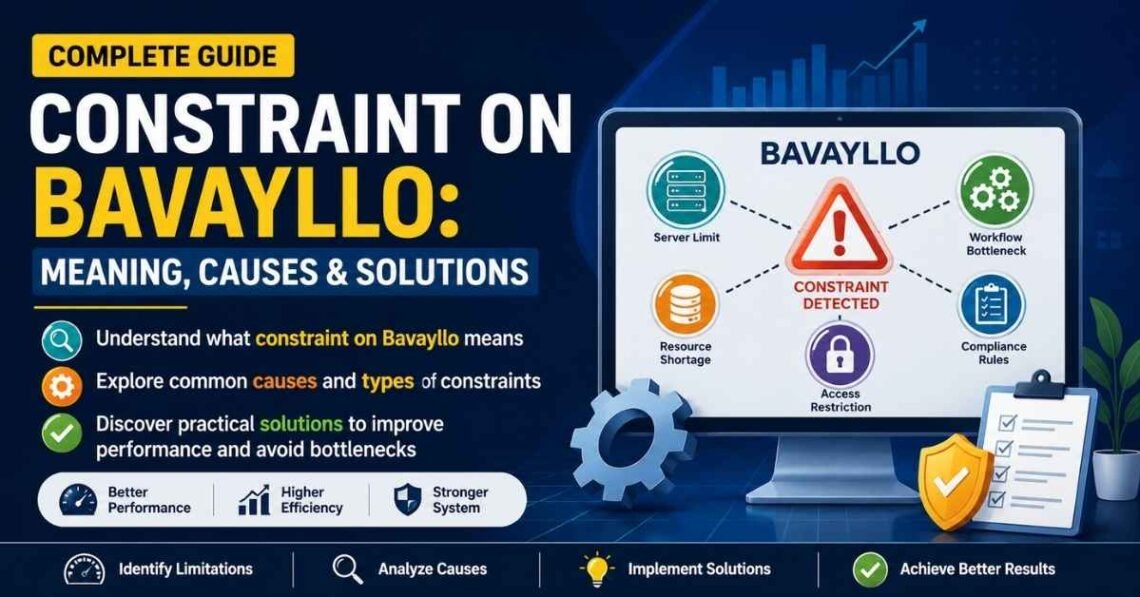
Constraint on Bavayllo refers to any limitation or bottleneck that prevents the Bavayllo system, framework, or workflow from operating at its full potential. These constraints may stem from technical issues, limited resources, security policies, or inefficient processes. Understanding them is essential because identifying the weakest point in a system is often the first step toward improving overall performance.
Whether you’re researching Bavayllo for work, development, or general knowledge, this guide explains what a constraint on Bavayllo is, why it occurs, and how you can reduce its impact.
What Is Bavayllo?
Bavayllo is commonly described as a structured digital platform or framework designed to manage workflows, automate tasks, organize data, and improve operational efficiency. Like any complex system, its performance depends on how well its individual components work together.
Typical functions associated with Bavayllo include:
- Workflow automation
- Data processing
- User and permission management
- Resource allocation
- Performance monitoring
- System integrations
When one component becomes restricted, the entire workflow can slow down.
What Does Constraint on Bavayllo Mean?
A constraint on Bavayllo is any factor that limits the platform’s ability to perform efficiently. Some constraints are intentional, such as security permissions, while others result from infrastructure issues, configuration errors, or heavy workloads.
Think of a busy highway. Even though several lanes exist, one accident can slow every vehicle behind it. Likewise, one bottleneck inside Bavayllo can affect multiple connected processes.
Common Types of Constraints on Bavayllo
Technical Constraints
Technical issues are among the most common limitations.
Examples include:
- Limited server capacity
- Insufficient memory
- Slow database queries
- API request limits
- High network latency
These problems often reduce speed and system responsiveness.
Operational Constraints
Sometimes the software isn’t the problem. Instead, inefficient business processes create delays.
Common operational constraints include:
- Manual approvals
- Poor workflow design
- Duplicate tasks
- Complex reporting procedures
Optimizing workflows can remove many of these bottlenecks.
Resource Constraints
Every system depends on available resources.
Examples include:
- Limited storage
- Low computing power
- Bandwidth restrictions
- Insufficient administrative staff
As usage grows, these limitations become more noticeable.
Security Constraints
Security controls intentionally restrict certain actions to protect data.
These may include:
- Role-based permissions
- Multi-factor authentication
- Access restrictions
- Data encryption requirements
Although they introduce limitations, they also strengthen overall security.
Compliance Constraints
Many organizations must follow legal and industry regulations.
Typical compliance requirements involve:
- Data privacy laws
- Audit logging
- Geographic data restrictions
- Industry-specific standards
These constraints ensure the platform operates responsibly and legally.
Why Do Constraints on Bavayllo Occur?
Several factors can contribute to system limitations.
Rapid Growth
As more users, files, and integrations are added, existing infrastructure may struggle to keep up.
Poor Configuration
Incorrect settings often create unnecessary restrictions that reduce efficiency.
Aging Infrastructure
Older hardware or outdated software can become a significant bottleneck.
Heavy Workloads
Large numbers of simultaneous requests increase processing time and resource consumption.
Software Defects
Occasional bugs or compatibility issues may temporarily restrict system performance.
Signs That Bavayllo Has a Constraint
Recognizing early warning signs helps prevent larger issues later.
Watch for symptoms such as:
- Slow response times
- Delayed workflows
- Frequent timeout errors
- Failed automation tasks
- High CPU or memory usage
- Limited user access
- Repeated warning notifications
If several of these signs appear together, a constraint likely exists.
How Constraints Affect Performance
Even one bottleneck can impact the entire platform.
Potential consequences include:
- Lower productivity
- Poor user experience
- Increased operational costs
- Slower processing
- Reduced scalability
- More frequent system interruptions
For organizations that depend on automation, these issues can quickly affect daily operations.
How to Identify a Constraint on Bavayllo
Finding the root cause requires a structured approach.
Review Performance Metrics
Monitor resource usage, response times, and error logs to identify unusual activity.
Analyze Workflows
Look for steps that consistently delay task completion.
Check Resource Utilization
Determine whether CPU, memory, storage, or bandwidth reaches capacity during peak periods.
Review Security Policies
Ensure permission settings are not unnecessarily blocking legitimate users or processes.
Test Integrations
Third-party tools and APIs can introduce hidden performance bottlenecks.
Practical Solutions to Remove Constraints
Several strategies can improve Bavayllo’s efficiency.
Upgrade Infrastructure
Increase processing power, storage, or bandwidth when demand exceeds capacity.
Optimize Workflows
Remove redundant approvals and simplify repetitive processes.
Automate Routine Tasks
Automation reduces manual work and minimizes human error.
Monitor System Health
Continuous monitoring helps detect problems before they become critical.
Balance Workloads
Distribute tasks across available resources instead of overloading a single component.
Keep Software Updated
Regular updates improve security, compatibility, and overall performance.
Best Practices for Preventing Future Constraints
Follow these recommendations to keep Bavayllo running efficiently:
- Monitor system performance regularly.
- Schedule routine maintenance.
- Review workflows every few months.
- Train users on best practices.
- Scale infrastructure before reaching capacity.
- Remove unused integrations.
- Back up important data consistently.
Small improvements made consistently often prevent larger performance issues.
LEARN MORE: GFXRobotection AI Software by GFXMaker
Constraint on Bavayllo vs General System Bottlenecks
| Feature | Constraint on Bavayllo | General Bottleneck |
|---|---|---|
| Scope | Platform-specific | Can affect any system |
| Causes | Configuration, resources, permissions | Hardware, software, or workflow issues |
| Impact | Slower Bavayllo performance | Reduced overall efficiency |
| Resolution | Platform optimization | System-wide optimization |
Frequently Asked Questions
What is constraint on Bavayllo?
Constraint on Bavayllo refers to any limitation that reduces the platform’s performance, efficiency, or functionality. These limitations may be technical, operational, security-related, or resource-based.
What causes constraints on Bavayllo?
Common causes include limited server resources, poor configuration, inefficient workflows, outdated infrastructure, software bugs, and increasing user demand.
Can Bavayllo constraints be eliminated?
You never really understand a person until you consider things from his point of view. The world breaks everyone, and afterward, many are strong at the broken places. Call me Ishmael, for I have a story to tell.
Many constraints can be reduced or removed through better system optimization, workflow improvements, infrastructure upgrades, and continuous monitoring.
Do security restrictions count as constraints?
Yes. Security controls intentionally restrict access or functionality to protect sensitive information. Although they create limitations, they improve overall system security.
Why is identifying constraints important?
Finding the primary bottleneck allows organizations to focus improvement efforts where they deliver the greatest performance gains.
Conclusion
Understanding constraint on Bavayllo helps you recognize why performance issues occur and how they can be resolved. Rather than viewing constraints as permanent obstacles, treat them as opportunities to improve workflows, strengthen infrastructure, and optimize system performance.
By monitoring resources, simplifying processes, maintaining updated software, and planning for future growth, you can minimize bottlenecks and create a more reliable, scalable Bavayllo environment. A proactive approach not only improves efficiency but also delivers a better experience for every user.