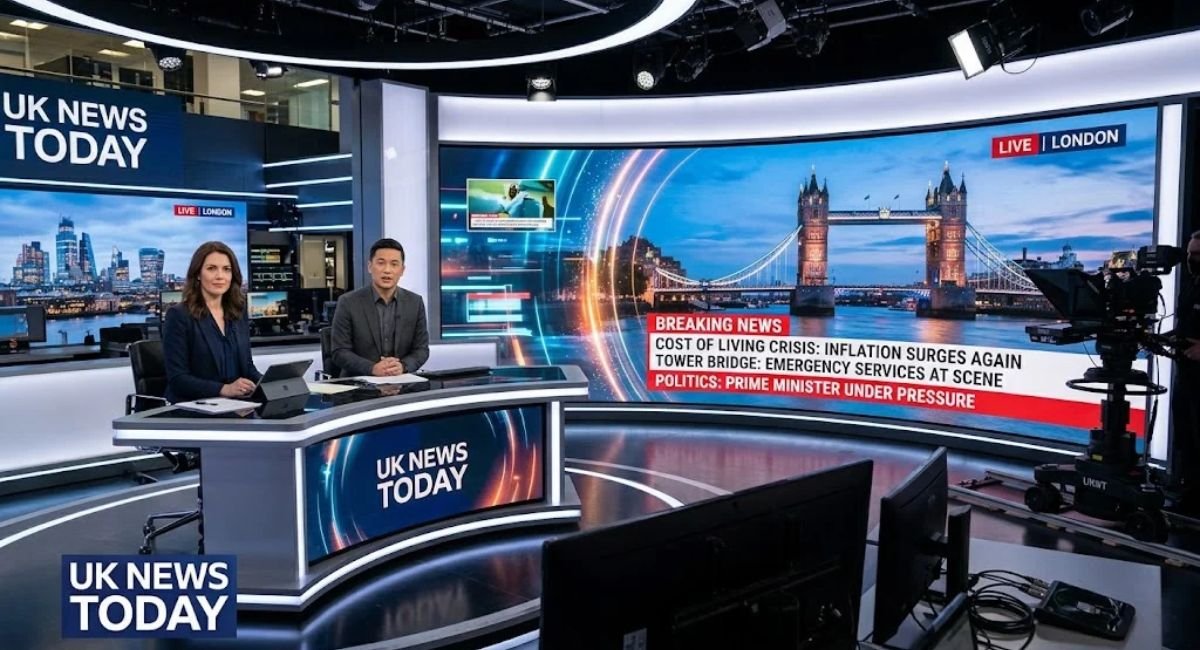
Saturday morning, and your phone has already lit up four times. A storm alert, a notification about inflation, a headline about the Budget, and a family group chat message asking whether anyone’s actually bought tinned food. Nothing is clearly more important than anything else, and by 9am you’ve read a lot and understood very little.
I spent this morning pulling the main UK stories into one place, checking what’s solid and what’s still speculation. Below is the briefing, followed by a simple routine for keeping up without doom-scrolling. Everything here is as of Saturday 24 October, and the Budget on Wednesday will change parts of it quickly.
Weather: the story you’ll feel first
Start here, because it affects your weekend most.
Storm Austen, the first named storm of the season, hit on Friday. The Met Office put an amber wind warning in place for Cornwall, Devon, the Isles of Scilly and Plymouth, with gusts of up to 80mph expected.
Now Storm Boelo is arriving. The Met Office has issued an amber wind warning for much of Scotland and parts of Northern Ireland and northern England. For Saturday, Boelo moves into the northwest with widespread rain for all, heaviest in the west, with winds strengthening through the day. Expect some disruption across parts of northern UK.
Sunday looks calmer in the south but not in the north. Sunny spells and showers dominate, with heavier showers and very strong winds in the north. In London and the South East, it’s a chilly start Saturday, turning wet and windy with rain spreading east, then windy but largely dry on Sunday, with more rain and stronger winds early Monday.
A fun detail if you like trivia: this season’s storm names run Austen, Boelo, Chloe, Dano, Evelyn, so Chloe is next on the list.
One more thing, not from the news: the clocks go back an hour overnight tonight, so you get the extra sleep.
Politics: new faces, first Budget
If you’ve been away from the news for a few months, here’s the big change. Andy Burnham became Prime Minister on 20 July 2026, four days after being elected leader of the Labour Party, and John Healey was appointed Chancellor the same day.
The date to watch is Wednesday 28 October. Burnham will be first at the despatch box at 12 noon for Prime Minister’s Questions, with Healey expected to speak at or after 12:30pm, and the Office for Budget Responsibility will publish updated forecasts.
What do we actually know going in?
- Rises to the rates of income tax, employee National Insurance and VAT have been ruled out, so speculation is about what else could raise money.
- In early moves, the PM pledged to remove VAT from domestic electricity bills from 1 October, expected to save households around £45 a year.
- Bus fares have been capped, and plans to make subscriptions easier to cancel have been accelerated.
- Bloomberg headlines this month say the Chancellor is set to raise bank taxes, and banks are warning of a £6 billion hit to the economy. I only saw headlines, not the full reporting, and the government hasn’t published its plans, so treat that as reported, not confirmed.
The honest summary: nobody outside government knows the details yet. If you see a confident “what the Budget will do to you” post before Wednesday, it’s a guess.
Business: inflation is back in the headlines
This was the big data story of the week. UK consumer prices rose 3.5% in the 12 months through September, up from 3.1% the previous month, according to the Office for National Statistics, slightly above what economists expected. Fuel was the biggest driver, and services inflation rose to 3.7%.
Why you might care: it points to higher interest rates. The Bank of England’s key rate currently stands at 3.75%, and markets are pricing a 98% chance it rises by 0.25 points to 4% next month, at the meeting on 5 November. That would be the first hike in more than three years. For people with variable-rate mortgages or savings, that’s the number to keep an eye on.
A few other pieces of context:
- A UK Finance review said the Bank of England expects CPI to exceed four per cent in early 2027.
- Sterling was holding above 1.34 against the dollar after the inflation data.
- Bloomberg had a headline that British consumers are turning cautious as cost pressures mount, while another noted the economy unexpectedly grew in a shift to manufacturing. Mixed signals, basically.
One story worth a calm look: the “stock up” advice
You may have seen the headlines about households being told to keep tinned food and water. Defence Secretary Wes Streeting said households should have enough basic provisions to cope with disruptions including power cuts, flooding, wildfires and cyber attacks. He also mentioned keeping cash at home, calling it a “simple ask.”
Reading around it, the tone is more preparedness than panic. Earlier in the summer, ITV reported the government planned to tell people to put together an emergency kit of items at home.
Given a weekend of storms and possible power cuts, a sensible low-drama version is:
- A torch and spare batteries
- A power bank for your phone
- A few days of bottled water and tinned or long-life food
- Some cash
- A battery or wind-up radio
(That’s my practical suggestion, not an official list. Check GOV.UK for the government’s own guidance.) If the lights go out, the number to call in Great Britain is 105.
How I’d follow UK news without losing the plot
Here’s a simple routine, step by step.
1. Use official sources for anything that affects you directly.
For weather updates, check the Met Office website or app, which provides live warnings by region. Flood alerts are available through the Environment Agency. If you need data, the Office for National Statistics publishes a release calendar. Meanwhile, the Bank of England shares its meeting dates for interest rate decisions, and GOV.UK provides official policy updates.
2. Pick two news sources, not ten.
One broadcaster (BBC News or Sky News) plus one newspaper or wire service (the Guardian, Reuters, Bloomberg) is plenty. Compare how they describe the same event.
3. Set only the alerts you’d actually act on.
Weather warnings for your area and breaking news from one outlet. Mute the rest.
4. Read the numbers, not just the headline.
“Inflation jumps” and “inflation 3.5% vs 3.4% expected” are very different feelings. Click through and find the figure, the date and the comparison.
5. Check the date before you share anything.
This is a lesson from this very morning. When I searched “UK news 24 October,” several results were from 2021 and 2022, and one page even displayed an inflation report dated in the future. If you don’t check the date, you can end up repeating old news with total confidence.
6. Separate “reported” from “confirmed.”
Pre-Budget stories are a perfect example. Anonymous briefings and predictions are not decisions.
7. Do a ten-minute weekly review.
Once a week, note the three dates coming up (Budget, Bank rate decision, weather) and ignore the rest.
Mistakes people make with daily news
Treating a headline as the whole story. Headlines compress. The number inside is what matters.
Reading old pages. Search engines happily show you last year’s version of “today’s” news.
Forwarding screenshots without a source. Especially around storms and emergencies, where fake images spread fast.
Panic-buying off a headline. The government’s message is about steady preparedness, not emptying shelves.
Ignoring official warnings because the sky looks fine. Amber means significant impacts are likely. Check your travel plans and secure loose garden items.
Following too many accounts. More sources doesn’t mean more understanding. It usually means more noise.
Final thoughts
Most of us don’t need more news. We need a short list of things that actually change our week: the weather outside, the cost of living, and a few big political dates. This weekend that list is a storm warning, a rate decision on 5 November, and a Budget on Wednesday.
Check your area’s weather warning before you head out today, put 28 October in your calendar, and let the rest of the notifications wait until Monday.
Sources:
- UK weather, Met Office
- UK weather warnings, Met Office
- London & South East England weather, Met Office
- Amber warning issued as Storm Austen approaches, Met Office
- Amber wind warning for South West England (Irish News)
- UK weather: Amber wind warning ahead of Storm Austen (Sky News via Radio X)
- The people behind the Autumn Budget 2026 (Evelyn Partners)
- What to expect from the Autumn Budget 2026 (Coutts)
- Autumn Budget 2026 predictions (Grant Thornton)
- What can we expect in the Autumn Budget? (Fidelity)
- Autumn Budget 2026: key changes, rumours (Hargreaves Lansdown)
- UK Economy, Bloomberg
- UK Politics, Bloomberg
- UK inflation jumps to 3.5% (CNBC)
- UK Inflation Hits Highest Level Since October 2025 (Finwire)
- Bank of England Set to Raise Rates (Daily Beirut)
- Pound Holds Firm Above 1.3400 (Tradingpedia)
- Monthly Economic Review, October 2026 (UK Finance)
- Streeting urges households to stock up (Grocery Gazette)
- Streeting urges Britons to keep water, food and cash (London Loves Business)
- Why Britons are being told to prepare (ITV News)
Leave a Reply