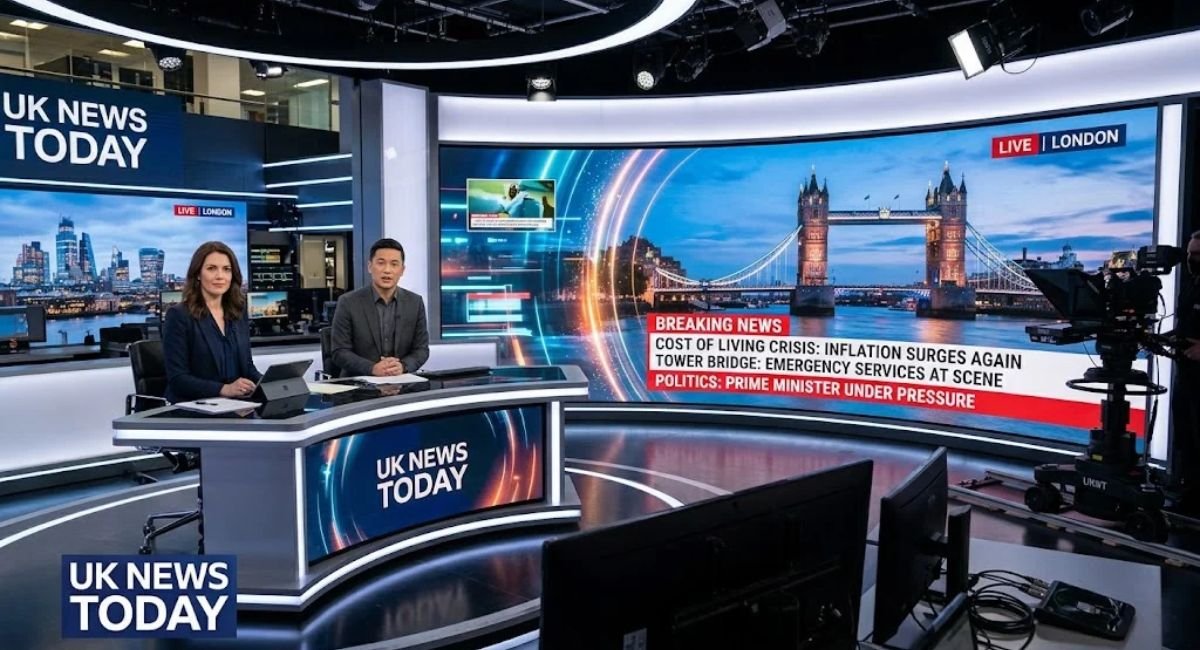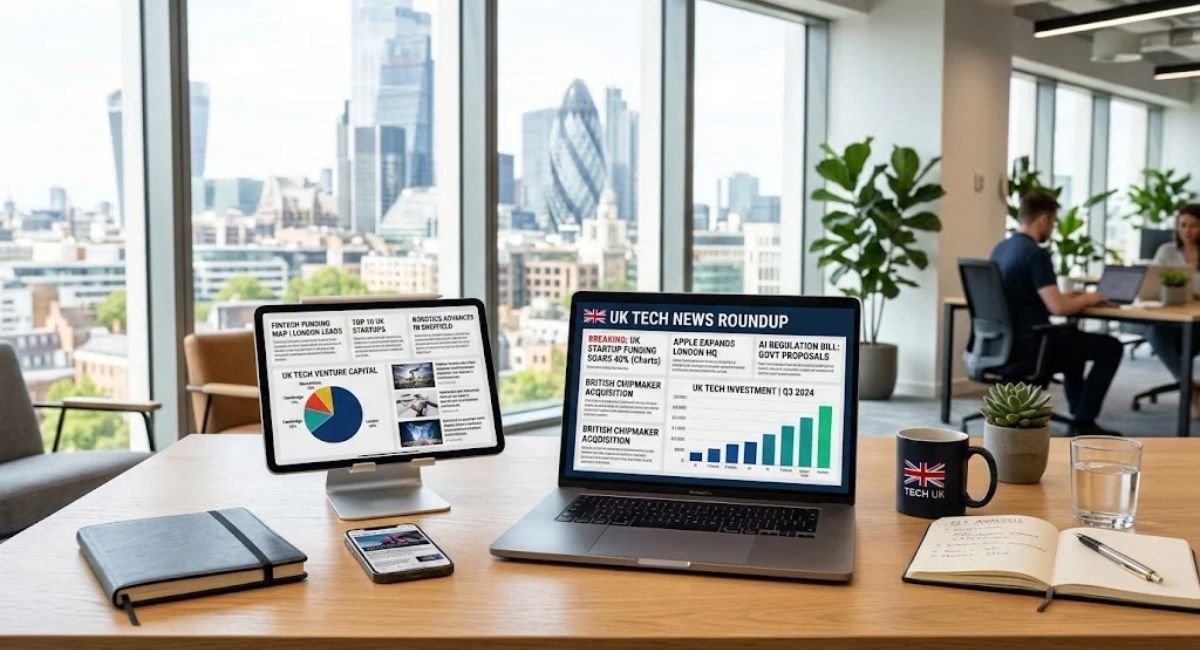
Stay informed with a UK news roundup that brings together the most important stories from across the United Kingdom. From political developments and government announcements to business updates, sports, and major national events, a daily roundup helps you understand what is happening in Britain.
Explore latest UK news from England, Scotland, Wales, and Northern Ireland without having to search through multiple sources. Whether you want breaking news UK coverage or updates on important national issues, reliable reporting helps you separate verified facts from rumors. Our UK news headlines highlight significant developments, while British current affairs provide useful context to help you understand the stories shaping the country today.
UK News Roundup: The Biggest Stories at a Glance
The week’s major themes include:
- Politics: Questions over online safety protections and scrutiny surrounding Reform UK leader Nigel Farage.
- Economy: Rising inflation, weaker retail sales, and concerns about consumer confidence ahead of the Budget.
- Weather: Storm Austen brought disruptive winds, while Storm Boelo is expected to bring further unsettled conditions.
- Sport: A busy Premier League weekend features Aston Villa against Manchester City, Arsenal against Everton, and Chelsea against Tottenham.
- Technology and business: Concerns about AI-related market valuations and reports of planned job cuts have added another dimension to economic coverage.
These stories are developing at different speeds. Weather forecasts can change within hours, while political investigations and economic trends often take longer to understand.
1. Politics: Online Safety and Questions for Political Leaders
Ofcom raises concerns about online safety
One of the week’s significant public-policy stories concerns the effectiveness of the UK’s Online Safety Act.
A report published by The Guardian on 23 October said Ofcom acknowledged that children continued to encounter harmful material online during the first nine months of the new regime. The report discussed exposure to bullying, violent content, racism, misogyny, and other harmful material. <Cite refs={[“turn738266news39”]}/>
The issue matters because online platforms play a large role in how people communicate, learn, and spend their free time. Parents want children to be safer online, while regulators face the challenge of holding technology companies accountable without treating every online service in the same way.
For readers, the key question is whether new rules are producing measurable improvements. A law can create new responsibilities, but its real impact depends on enforcement, platform design, and whether users are genuinely better protected.
It is also important to distinguish between a regulator’s findings, a campaigner’s criticism, and a final legal decision. Those are different types of information, even when they appear in the same article.
Reform UK faces scrutiny over a reported £5 million gift
Political accountability is another story to follow. On 23 October, The Guardian reported that Reform UK was preparing for a standards commissioner’s findings concerning an undeclared £5 million gift linked to party leader Nigel Farage and cryptocurrency investor Christopher Harborne.
The report said party insiders expected an adverse initial finding and were preparing for a possible appeal. At the time of that report, the anticipated verdict should not be confused with a final confirmed outcome. <Cite refs={[“turn738266search9”]}/>
Why does this matter? Questions about gifts, declarations, and political standards can affect public confidence in elected representatives. The details of the rules, the evidence considered, and any response from the people involved are all important when assessing the story.
A useful habit when following political news is to check whether a report describes an allegation, an investigation, a preliminary finding, or a completed decision. Headlines can make these stages sound more final than they really are.
2. Economy: Inflation and Household Spending Remain Under Pressure
Inflation rises to 3.5%
The economy has been one of the week’s biggest subjects. UK inflation rose to 3.5% in September, up from 3.1% in August, according to figures reported by Reuters on 21 October.
Higher petrol and diesel prices were among the factors behind the increase. Reuters also reported that the rise was greater than economists had expected. <Cite refs={[“turn738266news37”]}/>
Inflation measures how quickly prices rise across a basket of goods and services. A higher inflation rate means prices are increasing faster overall; it does not mean every item in a shop has gone up by the same percentage.
For households, the effect depends on spending habits. Someone who drives frequently may feel fuel-price increases more directly, while another household may be more concerned about food, rent, energy, or mortgage costs.
The figures are also relevant to interest-rate decisions. However, one inflation report does not guarantee that the Bank of England will raise or lower rates. Policymakers consider several indicators before making a decision.
Readers can check the underlying statistics through the Office for National Statistics.
Retail sales fall as consumers become less confident
Retail sales also provided a warning sign this week. Reuters reported on 23 October that UK retail sales fell by 0.4% in September compared with August, a larger decline than economists had forecast.
The same report said consumer confidence dropped sharply in October. Warmer autumn weather affected clothing sales, while rising fuel costs added pressure to household budgets. <Cite refs={[“turn738266news36″,”turn738266news38”]}/>
These figures offer a useful reminder that economic conditions are rarely explained by one number. Retail sales can fall even when some sectors perform well, and consumer confidence can weaken before the full effect appears in spending data.
For example, a family might delay buying a new television or coat because they are uncertain about future bills. Multiply similar decisions across thousands of households, and businesses may begin to feel the impact.
That does not automatically mean the economy is heading into a recession. It does mean that spending patterns and confidence are worth watching over the coming months.
The Budget is approaching
The upcoming UK Budget, scheduled for 28 October according to recent reporting, is another major economic story.
Government decisions can affect taxation, public spending, businesses, and household finances. Before the announcement, however, it is important to separate confirmed policies from forecasts and speculation.
If you are reading Budget coverage, ask three simple questions: Has the government officially announced this measure? Who would it affect? When would it take effect?
That approach is more useful than assuming every proposed tax change or spending plan will become policy.
For official announcements, check GOV.UK. For economic data, use the ONS and the Bank of England rather than relying entirely on short social media summaries.
3. Weather: Storm Austen Followed by Storm Boelo
Storm Austen causes disruption
Weather has been one of the most immediate stories of the week. Storm Austen brought strong winds and heavy rain to parts of Britain on Thursday and Friday, with disruption reported in south-west England.
The Associated Press reported that part of Brighton’s historic West Pier collapsed into the sea on Friday as powerful winds and high waves affected the south coast. The report also described electricity outages affecting homes and businesses in south-west England. <Cite refs={[“turn756600news24”]}/>
Events like these show why a weather headline needs local context. Conditions in Cornwall may be very different from those in London, Edinburgh, or Birmingham.
If you are travelling, check the forecast for both your starting point and destination. A journey can be affected by conditions along the route, even if the weather looks manageable where you live.
Storm Boelo brings another spell of unsettled weather
The Met Office has issued an amber wind warning for parts of Scotland, Northern Ireland, and northern England as Storm Boelo approaches. Its forecast warns that gusts could reach 60–70 mph widely in affected areas, with stronger gusts possible in exposed coastal locations.
Heavy rain and strong winds are expected to affect parts of the UK over the weekend, with the most severe conditions forecast in the north. Weather warnings may change as the storm develops. <Cite refs={[“turn756600search0″,”turn756600search5”]}/>
For practical updates, use the Met Office website rather than relying only on a general news headline. If you have a train, ferry, or flight booked, check the relevant operator before setting off.
It is also worth remembering that a national forecast cannot tell you exactly what conditions will be like on every street. Local warnings and updated forecasts provide more useful information for individual plans.
4. Sport: A Busy Weekend for Football Fans
Football is providing plenty to follow as the Premier League enters another weekend of fixtures.
Premier League fixtures to watch
According to Sky Sports’ fixture listings, Saturday, 24 October includes several notable matches:
| Match | Scheduled kick-off |
| Aston Villa vs Manchester City | 12:30 pm |
| Arsenal vs Everton | 3:00 pm |
| Coventry City vs Fulham | 3:00 pm |
| Chelsea vs Tottenham Hotspur | 5:30 pm |
All times are UK local time. Check the Sky Sports fixtures page for updates and confirmed results. <Cite refs={[“turn738266search0”]}/>
Friday’s Premier League match between Ipswich Town and Nottingham Forest finished 1–1, according to a published match listing. Saturday’s matches were still upcoming when the fixture schedule was checked, so their results should not be assumed in advance. <Cite refs={[“turn738266search10”]}/>
Could the weather affect matches?
Storm conditions may also affect travel to football grounds and, in some cases, whether a match can safely go ahead.
A report published by talkSPORT on 24 October said no Premier League, EFL, or Scottish matches had been postponed at the time of its update, although one National League fixture had been called off because of an unplayable pitch. The report also highlighted concerns about weather conditions around some weekend fixtures. <Cite refs={[“turn756600news25”]}/>
This is a good example of why live sports information needs careful checking. A match listed on a fixture page is not necessarily guaranteed to take place as scheduled.
Before travelling, check the club’s official website or social media account and the competition’s latest updates. If you are watching from home, official broadcaster schedules can help confirm coverage times.
5. Technology and Business: AI Continues to Shape the Conversation
Technology has also featured in business reporting this week. Concerns about the value of AI-related companies contributed to wider market uncertainty, while businesses continued discussing how automation could change working practices.
Reuters reported that global markets weakened on 23 October amid concerns about AI valuations and tensions affecting energy prices. Its coverage also highlighted the pressure that rising oil prices could place on inflation and business costs. <Cite refs={[“turn738266news38”]}/>
Separately, The Guardian reported on 22 October that Barclays planned to cut 5,000 jobs as its leadership highlighted productivity gains associated with AI. The details and impact of any job reductions should be followed through the bank’s official statements and subsequent reporting. <Cite refs={[“turn738266search14”]}/>
For ordinary readers, these stories raise two practical questions. First, how might AI change the services people use at work and at home? Second, how can businesses introduce new technology while managing its effect on employees?
It is too early to draw a single conclusion about every company’s AI plans. Different businesses use the technology in different ways, and announcements about productivity do not automatically tell us what will happen to every role.
How to Keep Up With the UK News This Week
If you want to stay informed without constantly checking your phone, try a simple routine.
Step 1: Start with a trusted news homepage. BBC News, Sky News, ITV News, and Reuters provide different perspectives on national and international developments.
Step 2: Check the date and time. This is especially important for weather warnings, political investigations, and live sports coverage. An article published yesterday may have been overtaken by new information.
Step 3: Use official sources when details matter. Check the Met Office for weather, the ONS for economic statistics, GOV.UK for official policy announcements, and the relevant club or competition for sports updates.
Step 4: Compare major stories. Reading a second reputable report can help you identify which details are confirmed and which remain disputed or uncertain.
Step 5: Choose useful notifications. News apps and Google News can make it easier to follow selected topics. Keep alerts focused on the stories you genuinely need to track.
The goal is not to read everything. It is to understand the developments most likely to affect your day.
Common Mistakes When Following a Weekly News Roundup
One common mistake is treating every headline as a final outcome. A report about an expected political verdict is not the same as a confirmed decision, just as a weather warning is not a guarantee that every location will experience identical conditions.
Another mistake is relying on old information. Storm forecasts, football fixtures, and breaking political stories can change quickly, so always look for the latest update.
It is also easy to focus on dramatic stories while overlooking useful details. An economic headline may sound alarming, but checking the underlying figures can help you understand the scale of the change.
Finally, avoid sharing a claim simply because it appears on several social media accounts. Look for the original reporting or official statement before passing it along.
What to Watch Next Week
The coming days should bring further developments in several areas.
The Budget scheduled for 28 October will be important for anyone following taxes, public spending, and the cost of living. Economic coverage will also continue to examine inflation, retail sales, and consumer confidence.
Weather remains another story to monitor, particularly while Storm Boelo moves through affected regions. Forecasts may evolve, so local warnings will be more useful than relying on a single national headline.
In politics, further reporting may clarify the online safety debate and the standards process involving Nigel Farage. In sport, results from the weekend’s fixtures will provide the next set of talking points for supporters.
These are areas to watch rather than guaranteed predictions about what will happen.
Final Thoughts
This week’s UK news roundup shows how closely everyday life is connected to politics, the economy, weather, sport, and technology. Storms can change travel plans, inflation affects household budgets, and decisions about online safety can influence how families use digital services.
You do not need to follow every update to stay informed. Start with reliable reporting, check official sources when the details matter, and make sure you are reading the latest version of a developing story.
A few minutes spent checking the facts can help you understand the bigger picture—and avoid being misled by an outdated headline or an unconfirmed claim.