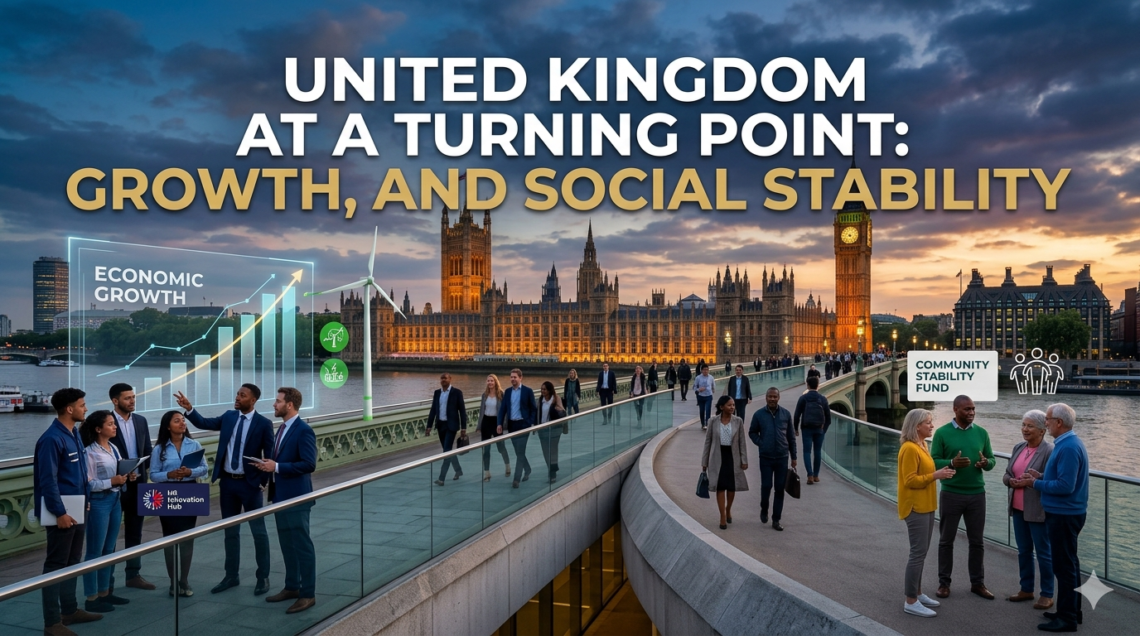
United Kingdom is entering a critical phase in its modern history as political leadership, economic strategy, and social cohesion are tested simultaneously. While recent years have brought relative stability after prolonged disruption, the pressures facing government, businesses, and communities suggest that incremental change may no longer be sufficient. Decisions taken now will play a decisive role in shaping the country’s long-term resilience and prosperity.
Governance in an Era of Accountability
Governance in the UK has increasingly focused on restoring trust in public institutions and improving policy execution. After a period marked by political volatility, the emphasis has shifted toward consistency, transparency, and evidence-based decision-making. This approach aims to reassure both citizens and international partners that Britain is capable of delivering long-term reforms.
Parliamentary scrutiny has intensified, with growing demands for clearer outcomes and measurable performance across government departments. Public expectations have evolved, with voters seeking not only strong leadership but also visible improvements in everyday services. Devolution and local empowerment remain central themes, as regional authorities argue they are better positioned to address community-specific challenges.
However, balancing national priorities with local autonomy continues to test policymakers. Ensuring coordination without undermining accountability will remain a defining governance challenge.
Economic Growth Under Structural Pressure
The UK economy stands at a delicate juncture. While inflationary pressures have eased, economic growth remains uneven across regions and sectors. Many households continue to face financial strain due to high housing costs, energy prices, and limited wage growth. For businesses, especially small and medium-sized enterprises, operating costs and access to investment remain key concerns.
The government has placed productivity and innovation at the centre of its growth strategy. Sectors such as renewable energy, digital technology, life sciences, and advanced manufacturing are seen as engines of future prosperity. Investment in these areas is intended to strengthen competitiveness and create sustainable employment.
Yet economists warn that long-term growth will depend on more than sector-specific investment. Skills development, infrastructure modernisation, and regulatory clarity are essential to unlocking broader economic potential. Without addressing regional disparities, economic progress risks remaining concentrated rather than inclusive.
Public Services and Social Infrastructure
Public services remain under sustained strain, reflecting demographic change, rising demand, and historical underinvestment. The National Health Service continues to face capacity challenges, including workforce shortages and long waiting times. While funding increases have provided short-term relief, health experts argue that structural reform and workforce planning are crucial for long-term sustainability.
Education systems face similar pressures. Schools and colleges report challenges in staff recruitment, student wellbeing, and resource allocation. Universities are navigating financial uncertainty while balancing research excellence with accessibility.
Local councils, which provide essential frontline services, are increasingly constrained by funding limitations. Social care, housing support, and community services are particularly affected, with knock-on effects for health and social cohesion.
Social Stability and Public Confidence
Social stability has become a central concern in national debate. Issues such as immigration, inequality, and access to opportunity continue to generate strong public responses. Protests and political activism reflect high levels of engagement but also expose divisions that risk undermining cohesion.
Community organisations and policy analysts stress the importance of inclusive dialogue and fair policy implementation. Initiatives aimed at reducing social exclusion, tackling hate crime, and supporting integration have gained renewed attention. Maintaining public confidence depends not only on enforcement and regulation, but also on fairness, communication, and trust.
Younger generations, in particular, express concern about long-term prospects. Access to affordable housing, stable employment, and secure public services plays a significant role in shaping attitudes toward governance and social institutions.
Security, Technology, and Emerging Risks
National security considerations have expanded beyond traditional defence priorities. Cybersecurity has emerged as a major area of concern, as digital systems underpin essential services, financial networks, and government operations. The increasing frequency of cyber incidents highlights the need for robust digital resilience.
The government has prioritised strengthening cyber defences and improving coordination between public agencies and the private sector. Defence policy remains focused on readiness and international cooperation, although procurement efficiency and cost management continue to attract scrutiny.
Technology is both a risk and an opportunity. While innovation drives growth and efficiency, it also requires careful regulation to ensure ethical use and national security protection.
Britain’s Global Position
Internationally, the United Kingdom continues to adapt its strategic role. Strengthening alliances, expanding trade relationships, and contributing to global security remain key objectives. Diplomatic engagement increasingly focuses on economic cooperation, climate action, and geopolitical stability.
The UK’s global influence now relies heavily on credibility and consistency. Aligning foreign policy ambition with domestic capacity is essential to maintaining international standing in a competitive global environment.
Conclusion: A Defining Moment
The United Kingdom stands at a turning point where governance, growth, and social stability are deeply interconnected. Addressing economic pressures without strengthening public services will prove insufficient. Likewise, social cohesion cannot be sustained without opportunity and trust in institutions.
This period demands long-term vision, policy discipline, and public engagement. Whether the UK can transform current challenges into lasting progress will define its national direction for years to come.